
My Top 5 Learnings From Warren Buffett’s Letters To Shareholders

Introduction
Warren Buffett has been writing letters to his Berkshire Hathaway shareholders for over sixty years now.
These are not ordinary corporate letters filled with complex jargon and numbers. These are simple letters written in plain, honest English. They carry more practical investing wisdom than most books you will ever read on the subject.
Most people in India have heard of Warren Buffett. We know he is one of the wealthiest people on the planet. We know he is a legendary investor. But very few of us have actually sat down and read what he writes every year.
And that, I think, is a missed opportunity. Why?
Because what he shares in those letters applies directly to people like you and me.
Whether we are investing Rs. 1,000 a month in a SIP or managing a larger equity portfolio, all types of equity investors can benefit from it. You can also buy them on Amazon India.
I have spent considerable time reading these letters, and in this post, I want to share my top five takeaways from these letters.

Table of Contents
Learning 1: The Power of Retained Earnings
Let me start with something that will sound a bit technical.
When a well-managed company earns profits, it does not distribute everything back to its shareholders as dividends. A significant portion of those profits is kept inside the business and reinvested.
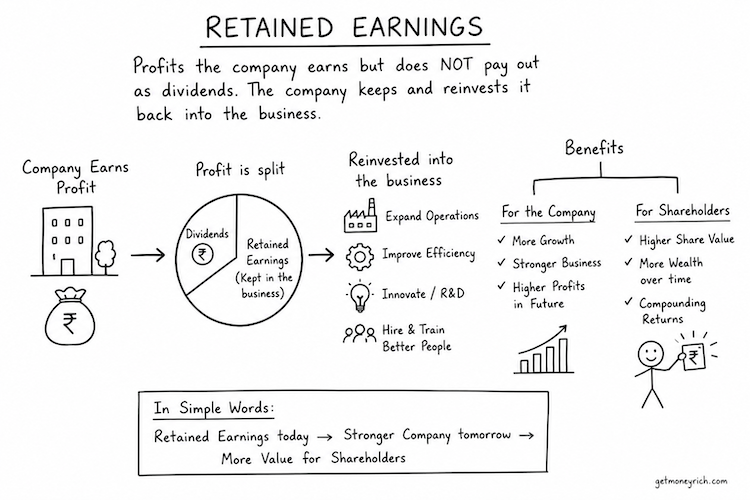
The reinvestment is done to expand capacity, to modernise operations, to enter new markets. This is done to make the existing business even stronger.
- This retained money then earns more profit.
- Which is again retained and reinvested.
- And this cycle keeps repeating, year after year.
Think of it like a small grocery shop owner in your locality.
At the end of the year, instead of spending all his profit on personal expenses, he uses some of it to do the following:
- Add a new product section,
- Get a better billing system,
- Hire one more person.
- The following year, the shop earns more. He reinvests again.
This way, over ten years, that small kirana has become a full-fledged grocery store. That is retained earnings doing its job quietly, in the background.
Now, Buffett applies this concept of retained earnings at an extraordinary scale.
His company, Berkshire Hathaway, reinvested $121 billion back into its own businesses over just one decade. Not into outside acquisitions, but back into the companies it wholly owned.
He calls these companies “commercial cows.”
Just like a good dairy cow that produces milk year after year without needing to be replaced, these businesses keep generating cash, decade after decade.
And this cash is used to make the company even stronger.
For us as investors, the learning here is simple.
When you identify a company that is not just earning profits but consistently reinvesting those profits to grow further, you have found something worth holding on to. You are not just buying a stock; you are letting a well-run machine work on your behalf.
Now, you do not have to do a single thing after that. The compounding will happen on its own.
Learning 2: The Moat
Retained earnings work beautifully, but only in businesses that are genuinely strong and protected.
Which brings me to the second learning: the concept of a Moat.
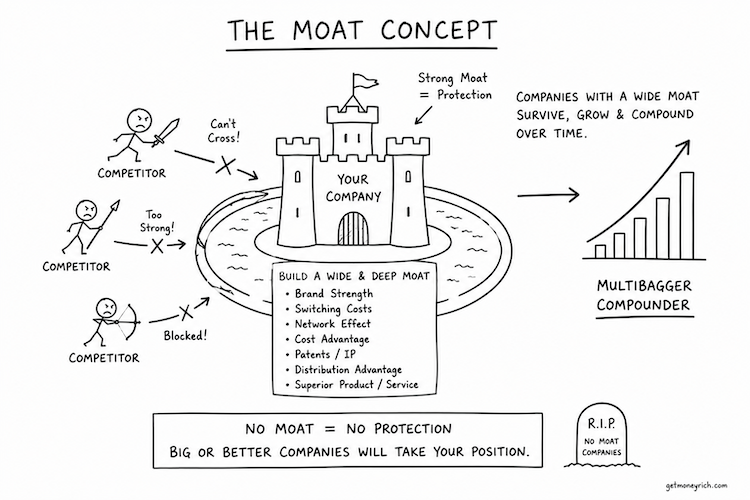
In old times, big castles used to surround themselves with a deep trench filled with water. This trench was called a moat.
The purpose of the moat was simple. They were built to prevent enemies from attacking the castle.
In business, a moat is anything that protects a company from its competitors.
And why does a business need this protection?
Because the moment any company starts making good money, others will try to copy it. They will imitate the product, undercut the price, or try to poach the best employees.
If a business does not have something that makes it genuinely difficult to challenge, its profits will eventually be eaten away.
Let me give you an example that every Indian will immediately understand — Fevicol.
When a carpenter comes to your home to fix a piece of furniture, you do not say, “Please use a good adhesive.” You say, “Please use Fevicol.” When a shelf breaks in your kitchen and you go to the hardware shop to buy glue, you do not ask for “glue.” You ask for “Fevicol.”
That one word (Fevicol) has become so deeply embedded in the Indian mind that no competitor, no matter how cheap or how aggressively marketed their product is, has been able to shake the dominance of Pidilite Industries (the company that makes Fevicol).
That is a moat.
Fevisol is a simple product. Nothing technologically complex. But the brand trust it has built over decades is so powerful that customers simply do not look for alternatives. This brand loyalty is the moat that protects Pidilite’s business and its profits.
Buffett makes one additional point here that I think is very important.
He says: If a business needs a superstar CEO to produce good results, then the business itself is not great. A truly strong business should be able to perform well even with an ordinary, competent manager at the helm.
The moat (the brand, the system, the competitive advantage) should be strong enough to carry the business on its own.
Other Indian companies that, in my view, have built wide economic moats include:
- Britannia,
- Nestle India,
- Asian Paints,
- HDFC Bank, etc.
Each of them has a different kind of moat.
Some built on brand loyalty, some on distribution reach, some on trust built over decades.
However, one caution here: stocks with wide moats are usually priced at premium valuations. They are rarely available cheaply. So while identifying these companies is important, buying them at a reasonable price requires patience. Read more about the price valuation analysis of stocks.
Learning 3: The Benefit of Doing Nothing
This is my personal favourite learning from Buffett’s letters. I think you will also like it, especially if you have been investing in stocks.
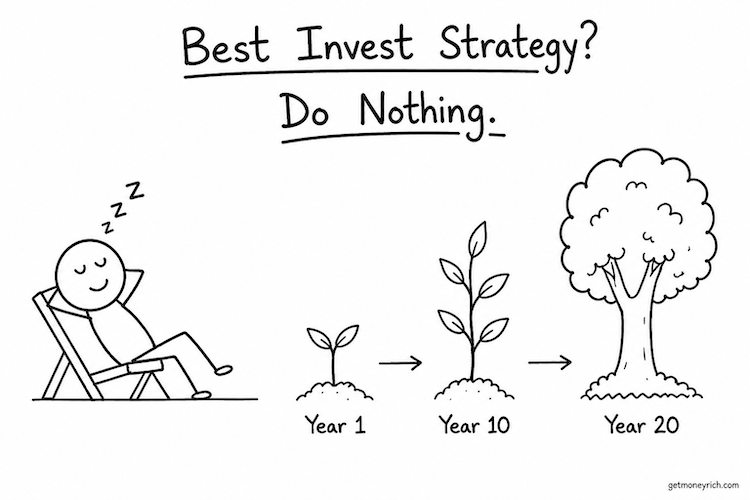
Buffett describes his investment approach as a kind of long, deep sleep.
It is like the story of Rip Van Winkle, the man who fell asleep and woke up decades later.
The idea is simple: once you have bought a great company at a reasonable price, the next best thing you can do is absolutely nothing. Do not trade it. Do not time the market. Do not check the price every morning. Just let it sit there and grow.
Let me give you a real Indian example that makes this point very powerfully.
Suppose you had bought 100 shares of Infosys back in 1999, at Rs. 12 per share. Your total investment would have been Rs. 1,200.
Now, imagine you somehow forgot about those shares. You put the share certificate in an old file, kept it in a drawer, and simply moved on with your life.
Today, those original 100 shares, after adjusting for all the bonus issues and stock splits that Infosys has carried out over the years, would have grown to approximately 25,600 shares.
At today’s price of around Rs. 1,200 per share, that original Rs. 1,200 investment is now worth approximately Rs. 3.07 crores.
- You did not do any technical analysis.
- You did not read a single quarterly result.
- You did not sell during market crashes or buy more during market rallies.
- You just did nothing.
- And that nothing turned Rs. 1,200 into over three crores.
Now, I know what some of you are thinking. This sounds easy in hindsight. And you are right.
The hard part is not identifying a good company. The hard part is doing nothing after you have bought it. Because the market will test you.
- Your stocks can fall 30-40%.
- The news channels will say the economy is collapsing.
- Your relatives will tell you to sell.
- Your broker will suggest switching to something “better.”
But the thing is, every single time you give in to that temptation, you interrupt the compounding process.
The people who actually made serious money from Infosys were not the ones who traded in and out regularly. They were the ones who simply held on and did nothing.
So, for you and me, the lesson is the same: activity in investing is mostly an expense, not an advantage. But a good quality company at a reasonable price, and keep it in your Demat Account for a decade. Do nothing else. You will be surprised by the amount of money you will accumulate.
Learning 4: The Circle of Competence
The fourth learning is, I think, the most underrated one. And it is also the one that most retail investors completely ignore. Why? Because we perceive this theory as something very complicated. But in reality, it is a simple way of life.
Buffett talks about something he calls the Circle of Competence.
The idea is simple. You do not need to understand every company, every sector, or every new investment trend that comes along. You only need to understand the businesses that are either already in your portfolio or that you are seriously considering investing in.
You should know about these companies well enough to make a reasonable estimate of what they will earn over the next five to ten years.
If you cannot make that estimate with some confidence, you move on. You simply do not invest.
Think about your own professional life for a moment.
If you have spent fifteen years working in the pharmaceutical industry, you understand how drug companies operate, what their cost structures look like, how regulatory approvals affect them, and which companies have strong R&D pipelines.
That is your circle. That is where you have an edge.
Banking stocks, technology companies, or commodity businesses may be completely outside your experience. If they are, you have no business investing in them just because someone recommended them at a dinner party.
Here in India, we feel enormous pressure to have an opinion on everything.
A colleague mentions a hot new IPO, and we feel we should know about it. A news channel is saying some infrastructure stocks will triple in a year, and we feel we are missing out.
This FOMO is one of the most dangerous emotions in equity investing.
Buffett himself openly admits that he has no idea what a large number of companies will look like ten years from now. He simply stays within the areas where he has a deep understanding.
If even he can say that, surely we can allow ourselves the same honesty.
Building your circle of competence takes time. It requires reading about the company, about its industry, about its competitors, and about its management.
But over time, as your understanding deepens, something valuable happens: you no longer need to chase the next IPO or react to every market rumour.
You know what you own, you know why you own it, and you know roughly how it will perform. That clarity is priceless.
Learning 5: The Tailwind — Never Bet Against Long-Term Progress
The final learning is perhaps the most powerful one.
Buffett talks about what he calls the American Tailwind.
In aviation, a tailwind is when the wind blows in the same direction as the aircraft. It pushes the plane forward without requiring any extra fuel.
Buffett argues that the United States, as an economy, has functioned as a tailwind for investors for over two hundred years. It has grown through multiple world wars, oil crises, recessions, political assassinations, financial crashes, and pandemics.
Through all of it, there were always voices predicting doom. And through all of it, the economy kept growing.
His conclusion from all of this is very simple: never bet against long-term progress.
What does it mean? Let’s understand it more clearly using India as our example.
- We have a young population. The median age in India is around 28 years, compared to 38 in the United States and 48 in Japan.
- We also have a growing middle class whose per capita income is steadily rising.
- We have a digital infrastructure like UPI, Aadhaar leading to deep internet penetration. It is reaching every corner of the country.
- Our economy, despite all its challenges and inefficiencies, is still expanding at a pace that very few large economies in the world can match.
If America’s two-hundred-year tailwind created the kind of wealth Buffett describes, India’s tailwind, which is still in its early decades, has the potential to do something similar for patient Indian investors over the coming generations.
And there is something great when you invest in a American tailwind like economy so early.
- You do not need to be an expert stock picker to benefit from this.
- You do not need to identify the next Infosys or the next HDFC Bank.
- You can simply invest in a good, low-cost Nifty 50 or Nifty 500 index fund, hold it for a long time.
- This way you are letting India’s own growth story do the heavy lifting for you.
The only serious mistake to avoid is making impulsive, panicked decisions when the market goes through one of its inevitable downturns.
Because downturns are temporary.
The long-term direction of a growing economy is upward.
Conclusion
Let me summarise the five learnings we have seen in this post:
- One: Find companies that reinvest their profits consistently and let that compounding work for you silently, over time.
- Two: Invest in businesses that have built a strong moat. The moat protects them from competition for years and decades. Fevicol, Britannia, Asian Paints these are examples of businesses with a wide moat. They are built on deep, durable competitive advantages.
- Three: Once you have bought a good company at a reasonable price, do nothing. Stop reacting to the market. Stop switching. Just hold, and let the plant grow.
- Four: Define your circle of competence. Read deeply about the companies you own. Ignore everything outside your circle, no matter how tempting it looks.
- Five: Trust the long-term growth story of your country. India’s tailwind is just beginning. You do not need to do anything brilliant. You just need to stay invested and avoid doing anything foolish.
Warren Buffett has made roughly one truly great investment decision every five years across his entire career.
The rest of the time, he was reading, thinking, and waiting.
That is a pace everyone of us can follow. In equity investing, finding one great investment every five-years can also make us super wealthy in times to come. It is needless to go on buying and selling stocks every week.
This is not investing, it is trading. Trading can generate cash flows for you (if you are an expert), but it will not make your wealthy.
Have a happy investing.
