
Why Companies Increase Authorized Share Capital: Understanding Equity Funding Through the RCPL Example

Query: Recently, I read this headline: “Reliance’s FMCG arm RCPL’s authorized share capital hiked to Rs. 10K crore to fund expansion (read here).”
I know that companies have mainly two sources of capital to fund their expansion projects: Debt and equity. The current headline, talking about “authorized capital,” is probably linked to equity. However, I’m unable to understand the logic behind the need to hike the authorized share capital. Also, tell me how to distinguish between authorized capital and paid-up capital.
Also, tell me how a share’s face value fits into this scheme of things. What happens when, suppose, Reliance Industries decides to buy shares of RCPL at an issue price above face value?
I’m actually confused about the concept of face value, issue price, etc.
Suppose a company’s authorized capital is 100. Its face value is Rs. 1. It means it can issue 100 shares and raise Rs 100. But if the company decides to sell its shares at Rs 500 per share, how will the capital raised be accounted for by the company?
I have also heard that, though, a company (like RCPL) got its Authorized capital increased by Rs 10k crore, but they can even raise whatever money they want (say even Rs. 10 Lakh crore). Is this understanding true or not?
Answer:
Let’s start with the concept of Authorized capital and paid-up capital.
To understand the concept of Authorized Share Capital, think of a company’s capital structure as a “storage container.“ The paid-up capital is the “liquid” inside it.
1. Authorized Capital is a Legal Ceiling
Authorized Capital is the maximum amount of share capital a company is legally allowed to issue to its shareholders.
There is a legal document called the MOA (Memorandum of Association). In this document, the company must declare the quantum of its authorized capital.
- The Constraint: A company cannot accept more equity investment than its authorized limit. Suppose there is a company whose authorized share capital is Rs. 200 crore. In the balance sheet of this company, the declared “share capital” should not be more than Rs. 200.
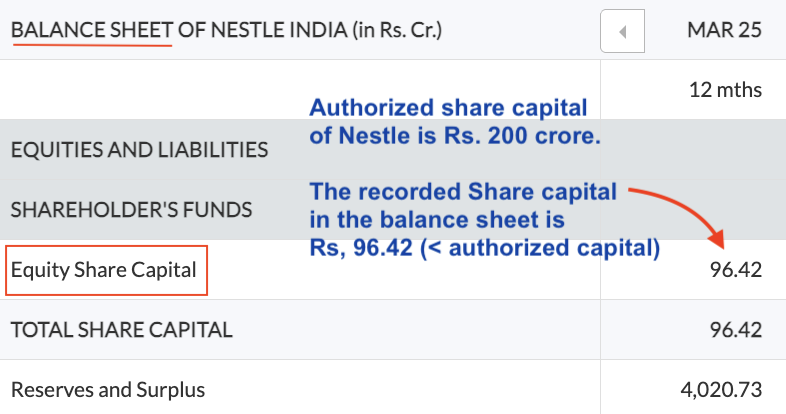
In our example of RCPL, by raising the limit to Rs. 10,000 crore, the company is essentially preparing a bigger “container” so it can receive huge amounts of cash in the future without having to ask for legal permission every single time.
Note: In a balance sheet, when a line item reads “Equity Share Capital,” it is actually “Total Paid-up Share Capital.” Whenever the term Authorized Share Capital is used in the discussion, the follow-up term that will be used next is always “Paid-up Share Capital.” The maximum value of Equity Share Capital (or Paid-up capital) will be equal to the authorized capital.
2. What’s the link between Authorized Share Capital & “Expansion” of a Company
The news headline that I read said that the amendment of Authorized Share Capital is to “fund expansion.” It indicates a specific sequence of events:
| Step | Action | Logic |
| Step 1 | Hike Authorized Capital | Creating the legal room to issue new shares. |
| Step 2 | Issue New Shares | RCPL will soon issue new shares to its parent (Reliance Industries) or other investors. |
| Step 3 | Cash Infusion | In exchange for those shares, the parent company will move actual cash into RCPL’s bank account. |
| Step 4 | Expansion | RCPL uses that cash to buy other brands (like Lotus Chocolate or Campa Cola), build factories, or set up distribution networks. |
3. The Business Strategy
Reliance is currently doing its “brand-buying” in the retail sector to compete with giants like Hindustan Unilever and ITC.
We must understand that when a company (like RCPL) has a high authorized limit of like Rs. 10,000 crore (already approved as per MOA), it can move instantly.
If a regional brand becomes available for acquisition tomorrow, RCPL can issue shares and get the cash from its parent company (Reliance) in days. In such a time, it will not have to wait to do the legal paperwork to raise funds.
If RCPL is moving from a small capital base to Rs. 10,000 crore authorized capital limit, it signals to the market that Reliance intends to pump billions of dollars into this specific business.
So, we must note that RCPL hasn’t actually raised Rs. 10,000 crore yet. It has simply increased its legal limit so that it can raise that much money from its parent company (Reliance) when needed.
4. How much capital can a company raise from equity if its Authorized Capital base is Rs. 10,000 Crore?
The quantum of the authorized capital, such as the value of Rs. 10,000 of RCPL, is almost like a dummy number. It means almost nothing to the company.
However, the company benefits in otherways from amending the authorized capital limit. It gets more free shares to issue and raise funds.
What does it mean? To understand this, we must first introduce three new terms in our discussion: Face Value, issue price, and Security Premium.
- Face Value (FV): It is a nominal value (Rs. 1 or Rs. 10) assigned to a share just for accounting and legal purposes only. It has no relation to the company’s actual or market valuations. To understand more about: Is it better to buy stocks with a face value of Rs. 1 or Rs. 10, read this post.
- Issue Price: This is the actual price an investor (like Reliance Industries) pays to the company (RCPL) for each share.
- Share Premium (Securities Premium): The difference between the Issue Price and the Face Value.
Issue Price = Face Value + Securities Premium
Let’s understand them more clearly by using a simple example.
Suppose a company’s authorized capital is 100. Its face value is Rs. 1. It means it can issue 100 shares and raise Rs 100. This is what we’ve learnt till now, right?
But suppose, if the company decides to sell its shares at Rs 500 per share (not at the face value of Rs. 1), is it legal? If yes, then what will be its “Equity Share Capital (Paid-up Capital)” as recorded in the balance sheet?
This is where most people get confused.
Even if you raise Rs. 50,000 (100 nos x Rs. 500) in cash, your “Share Capital (Paid-up capital)” on the balance sheet does not become Rs. 50,000. It stays at Rs. 100 (equal to the authorized capital).
So, what happens to the balance of Rs. 49,900? It is accounted as below:
| Account Category | Entry Name | Calculation | Amount |
| Assets | Total Cash Received | 100 shares x Rs. 500 | Rs. 50,000 |
| Equity | Paid-up Share Capital | 100 shares x Rs. 1 Face Value | Rs. 100 |
| Reserves & Surplus | Securities Premium | 100 shares x Rs. 499 Premium | Rs. 49,900 |
Why RCPL Hiked The Authorized Capital to Rs. 10,000 Crore?
Let’s say the Face Value of RCPL’s share is Rs. 10.
So now, if RCPL is hiking its authorized capital to Rs. 10,000 crore, they are actually preparing to issue 1,000 crore shares.
If they sell those shares to the parent company (Reliance Industries) at a premium (e.g., Rs. 100 per share), they could actually bring in Rs. 100,000 crore in cash while only filling up Rs. 10,000 crore of their authorized limit.
Remember, RCPL can also sell its shares at a price much higher than Rs. 100 per share. Till there are buyers, a company can sell its shares at any price.
Conclusion
Authorized Capital is a limit on the number of “legal units” (shares) a company can issue. It is not a limit on the actual money the company can receive.
The amount of money that the company can receive depends on the premium that the company is charging over and above its face value.
Issue Price = Face Value + Securities Premium
If a company can sell its share at a massive premium, why bother about the amendment of the Authorized Capital limit?
There are three strategic reasons:
- Valuation Logic: You can only sell a share at a premium if the company is actually worth that much. RCPL is a relatively new arm; they might not be able to justify a Rs. 1,000 premium per share yet (for example). To raise large sums of money early on, they need to issue a large volume of shares at a lower price.
- Using Authorized Capital as a Buffer: By setting the limit at Rs. 10,000 crore, they are telling the market (peers): “We plan to issue up to 1,000 crore shares (if FV is Rs. 10). Even at a modest premium, we are prepared to bring in hundreds of billions of rupees.”
- Stamp Duty & Paperwork: Every time you increase Authorized Capital, you pay a filing fee (Stamp Duty) to the Government. Instead of doing it 10 times in small increments, Reliance is doing it once in a massive jump to clear the path for the next 5–10 years of growth.
By hiking the authorized capital limit, Reliance is preparing to do something bigger in times to come.
Have a happy investing.
Please wait for my next article. You can also subscribe to my newsletters and get notifications of a new post right into your inbox.
