
Overall Score and Shares Pledge: Why Stock Engine Is Smart

Introduction
A few weeks back, I was poking around in the portfolio of Quant Small Cap Fund. One stock that caught my eye was Indian Hume Pipe.
It’s been a steady holding for them over the last two years, with a consistent 7.6918 lakh shares in their portfolio since last 2 years (July 2023 to July 2025).
The value of this holding has swung between Rs.10.22 crore and Rs.41.32 crore, reflecting the stock’s price movements.
What really grabbed my attention, though, was its dirt-cheap P/E ratio of just 3.71. That’s the kind of number makes you sit up and take notice, right?.
Naturally, I wondered why my Stock Engine wasn’t screaming about this stock.
In this post I’ll share, how my updated Overall Score Algorithm, with its clever handling of pledged shares, quietly does a brilliant job.

Why Low P/E Stocks Get My Attention
Whenever I spot a stock with a low P/E, I get curious.
A P/E of 3.71, like Indian Hume Pipe’s, suggests the stock might be undervalued.
It’s like finding a good deal on sale at the local market. You want to know if it’s worth grabbing.
My first instinct is to check if any mutual funds are holding it. That’s how I landed on Quant Small Cap Fund’s consistent stake in Indian Hume Pipe.
If a fund like Quant is holding steady, it’s a sign the stock has something going for it.
But here’s the twist: my Stock Engine wasn’t flashing this stock as a top pick. Why not?
The Hidden Risk of Pledged Shares
Digging deeper, I found the answer.
Indian Hume Pipe’s promoters have pledged about 24–25% of their shares.
For those new to this, pledged shares are when promoters use their shares as collateral for loans. It’s like taking a loan against your gold jewellery.
If the loan goes bad, the lender can sell those shares, and the stock price can crash. We’ve seen this with companies like Zee Entertainment in the past.
It’s a risk, and my Stock Engine knows it.
That’s where the Overall Score Algorithm comes in, quietly doing its job to keep me from chasing risky bets.
The Old Algorithm: Too Harsh, Too Simple
I implemented this updated around 1.5 years back.
My friend and former colleague Prashant told me that I should show the shares pledged percentage on my Stock Engine app. He wanted to use this metric to also screen out high pledged shares using the Big Screener of the Stock Engine.
So, not only I included this metric in the app but I used it to penalize stocks if their shares pledged percentage was high.
How I did it, by penalizing it by rendering lower Overall Scores to them.
Earlier, the Stock Engine used a linear penalty for pledged shares. For example, If X% of shares were pledged, the Overall Score took a straight Y% hit.
This algo was easy to understand and implement, but it wasn’t perfect. Why? Because it treated a 20% pledge very differently from 20.5% pledge. That’s like scolding a kid for scoring 90% and not 91%.
It didn’t feel right. So I decided to update the Overall Score algorithm with a more uniform and linear score adjustment for shares pledge factor.
New Algorithm For Shares Pledge Metric
This was the updated Overall Score Algorithm:
if pledge_percent > X%:
    overall_score = 0
else:
    overall_score = overall_score * (1 - (pledge_percent / Y) ** n)

[variables: X = Pledge percent, Y = Constant, n = Penalty Curve Factor]
Don’t worry about the math. I’ll explain it to you.
This formula is like a wise uncle who knows when to be strict and when to let things slide. Here’s how it works:
- If more than X% of shares are pledged, the Overall Score automatically drops to zero. It’s a clear signal: too risky, stay clear of such stocks.
- For pledges below X%, the score is reduced using a quadratic penalty: 1 – (Pledge% / Y )^n. This method of handling numbers ensures that the penalty starts small but grows faster as pledging increases.
For a stock like Indian Hume Pipe, whose pledge percentage is about 25% pledge, the penalty is (25/Y)^n = A%.
If the stock’s raw Overall Score is 65, the adjusted score is 65 * (1 – A%) = 50 (say).
This type of handling of the number (pledge percentage), handles lower pledges gently but is tough on higher ones.
Why the Penalty Curve Makes Sense [factor “n”]
Why use a penalty curve factor?
Risk doesn’t grow in a straight line. A 5% pledge isn’t five times riskier than a 1% pledge.
The danger escalates as pledging increases. The formula’s penalty curve captures this appropriately.
It’s like driving on a road that gets rougher the further you go, the driver will ease off a bit at first, but slam the brakes if it gets too bumpy.
This ensures stocks like Indian Hume Pipe aren’t overly penalized but still reflect their true risk.
How It Stacks Up: Old vs. New
Let’s put numbers to it. Say a stock has an Overall Score of 100.
Here’s how the old and new algorithms compare:
| Pledge % | Old Method (Example) | New Method (Example) |
| 10% Pledge | Cuts the score to 90 | Cuts the score to 96 (say) |
| 25% Pledge | Cuts the score to 75 | Cuts the score to 85 (say) |
| 45% Pledge | Cuts the score to 40 | Cuts the score to 15 (say) |
Note: Just an example, actual algo will render different results.
This shows the new formula is more nuanced, considerate, and strict at the same time.
It is like a wise teacher handling sensitive students differently than mischevious kids. My algorithm will not overreact to small pledges but flags big risks.
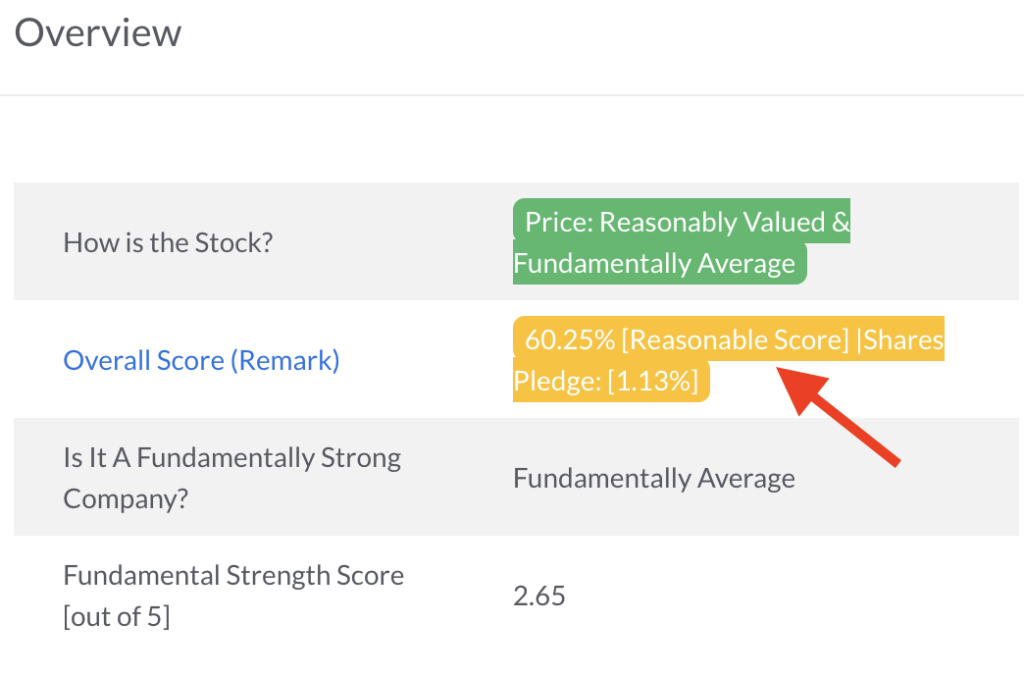
For a stock like Indian Hume Pipe, the 25% pledge lowers its score just enough to keep it off my top picks, even with that tempting P/E.
Conclusion
Stock Engine’s algorithm is balanced.
It doesn’t just chase low P/E stocks like Indian Hume Pipe blindly. It looks at the bigger picture, factoring in risks like pledged shares.
That’s why I trust my Stock Engine.
What is the lesson here for use as stock investors?
This experience with Indian Hume Pipe can teach us something. Low P/E stocks can look like bargains, but there’s often a catch. Pledged shares are one of those hidden traps. Probably, this is the main reason why big investors are not touching this stock and hence, its P/E is so low.
Stock Engine’s algorithm spot these intircate details. It is coded in a way that it does not overreach, and helps us see good opportunities.
It’s not perfect, no tool is, but it’s a step closer to making sense of the market’s chaos. As an Indian investor, I value that kind of clarity. Don’t you?
That is why I say, my Stock Engine is a quiet hero.
It can weigh a stock’s strengths and risks, and gives us a clearer picture.
It will not give you flashy numbers, because I’ve coded its been coded for practicality.
So, next time you’re eyeing a very low P/E stock, you know, you can check the Stock Engine to know where it may be lacking that’s causing its P/E to trade so low.
I trust my Stock Engine. It does the heavy lifting for me.
Have a happy investing.
