
How To Us AI to Read Annual Reports Faster and Do Fundamental Analysis?

Introduction
Reading annual reports has always been one of the most important parts of my fundamental analysis process. But over time, I realized something uncomfortable about this habit.
Most of the time spent reading annual reports was not actually spent thinking about the business.
Annual reports are long documents. Even for mid-sized companies, they easily cross 200–300 pages.
The challenge for me is not accessing the information; it is attention to detail and its deep interpretation. After reading so many reports, I’ve noticed that important signals are often buried between routine disclosures and remarks in the notes.
This is where I think using AI as a reading assistant is a good choice. I’ll still not use it as a decision maker.
My goal is simple: read annual reports faster without skipping important details.
In the last 1-2 years, I’ve built a method (workflow) for myself that now forms a core part of my fundamental analysis process. I use this process to read and interpret the long annual reports of companies faster.
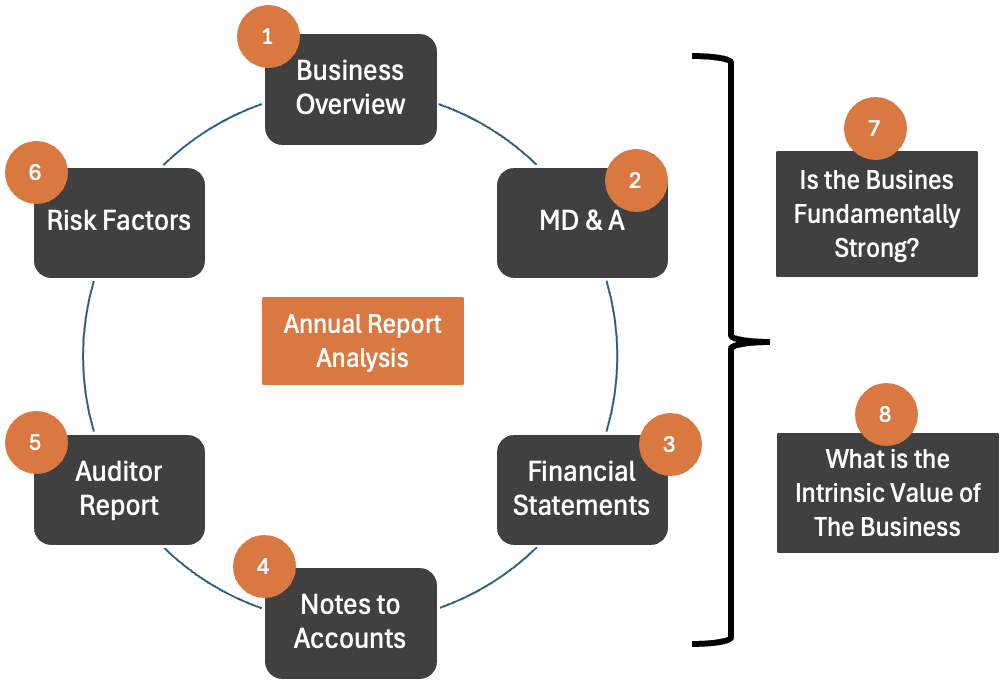
In this post, the details of the method I follow for the AI-assisted analysis of the Annual Report.
Table of Contents
- Introduction
- Why I Use AI in Annual Report Analysis
- Step 1 — Understanding the Business Overview
- Step 2 — Reading the MD&A with AI
- Step 3 — Interpreting Financial Statements
- Step 4 — Verifying Through Notes to Accounts
- Step 5 — Checking the Auditor’s Report
- Step 6 — Understanding Risk Factors
- Step 7 — Is the Company Fundamentally Strong?
- Step 8 — What Is the Intrinsic Value of the Business?
- Conclusion
Why I Use AI in Annual Report Analysis
At the outset, I’d like to make it clear that AI does not replace reading; it has just changed how I read the reports.
Instead of reading the annual report sequentially from the first page to the last page, I now read it in analysis order:
- Business first,
- Numbers later, and
- Verification at the end.
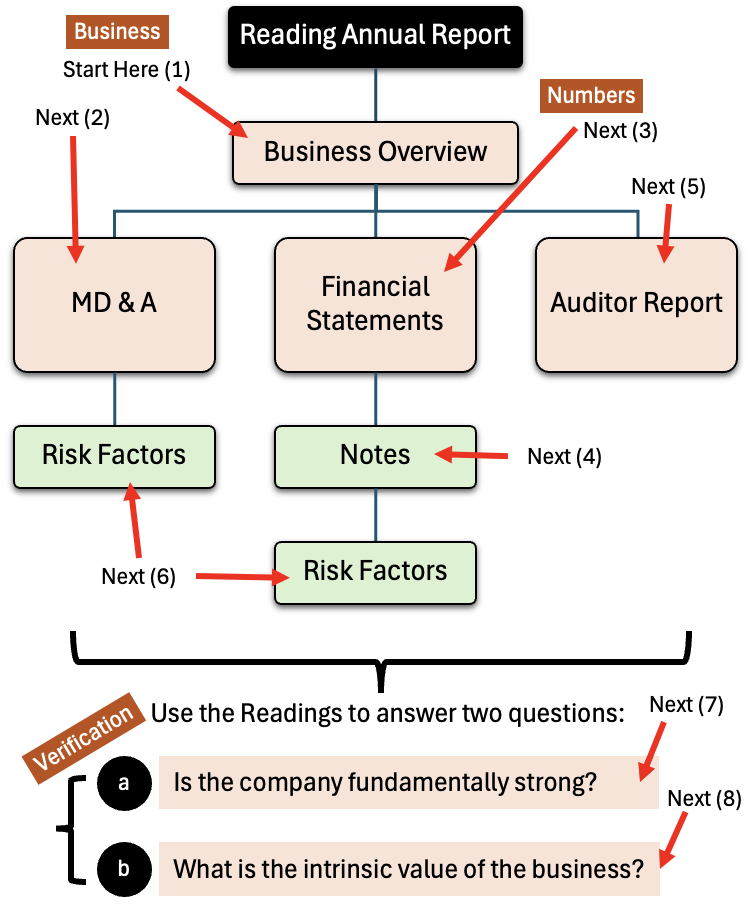
AI helps me interpret sections quickly so I can focus on judgment instead of only reading. This way, I have found that I’m spending the least time on extraction, which, according to me, was a useless task as it was very time-consuming.
My biggest benefit of using AI for data extraction and interpretation is the clarity I get after I’ve done the reading.
When I read long sections of an annual report, it can be difficult to figure out what actually matters and how different pieces of information connect to each other. This is where I find AI useful.
- I ask it to break large blocks of text into summarized explanations.
- I ask it to point out things like what is driving the business, what risks are mentioned, and what signals management may be giving.
By doing this, the information becomes easier to understand, and I can connect one section of the report to another without feeling overwhelmed.
Most importantly, AI helps me avoid two common mistakes investors make when reading annual reports:
- Getting lost in details that don’t matter
- Missing details that do matter
Step 1 — Understanding the Business Overview
When I start reading an annual report using AI, I don’t begin with the financial statements. I begin with the Business Overview section.
This way, I’m actually giving a context to my AI about the company. It gives AI the necessary understanding about the company before I ask it to analyze anything deeper.
My first step is to paste the Business Overview text into AI and ask it to explain the business model in simple terms.
- (A) I want to know how the company makes money.
This immediately removes the need to read multiple pages just to understand the basics of the company.
- (B) Next, I ask AI to identify the company’s main products, customer segments, and distribution model.
This helps me quickly see whether the business is product-driven, brand-driven, manufacturing-driven, or distribution-driven. With this clarity, the rest of the annual report becomes comparatively easier to interpret.
- (C) I also ask AI to point out anything that looks like a structural strength in the business.
The strengths can be a strong distribution network, manufacturing capability, brand positioning, or research and development advantage.
- (D) I ask AI to identify possible dependencies, like reliance on one plant, one category of products, or one type of customer.
This process usually takes just a few minutes, but it kind of builds for me a mental map of the company.
Instead of reading the annual report blindly, I now know what the business looks like, where its strengths may lie, and what areas I should pay attention to in later sections.
But I would like to say that using AI this way does not replace reading. I’ve found that almost all the time, my AI’s interpretation of what’s written in the ‘Business Overview’ section of the annual report matches only about 60% of mine. I think a human mind’s interpretation of business is still superior.
But for sure, AI gives me a great head start. It organizes my understanding before I go deeper into the report.
Once the Business Overview is clear, the Management Discussion & Analysis and financial statements become much easier to interpret.
AI Prompt for Business Overview Section
“Act as a long-term equity investor reading an annual report for fundamental analysis. Carefully read the Business Overview section provided below and explain the business in simple, clear language.
In your response, cover the following:

• What the company actually does and how it makes money
• The main products or services the company offers
• Who the company’s customers are
• How the company reaches its customers (distribution model)
• What appears to be the company’s core strength in its business model
• Any visible dependencies or business risks based on the overview
• A short explanation of the company in plain English as if teaching a beginner investor

Do not summarize line-by-line. Focus on helping an investor quickly understand the business model and structure. Avoid jargon and keep the explanation practical and easy to follow."
Step 2 — Reading the MD&A with AI
After understanding the business overview, the next section I move to is the Management Discussion & Analysis (MD&A).
For me, this is one of the most important sections of the annual report. This is that section of the annual report where management explains what actually happened during the year and why.
Reading this section gives me a perspective on what the company’s management is thinking about the company.
When I use AI for this section, my goal is not to summarize the text. Instead, I ask AI to help me understand how management is explaining performance.
I usually paste the MD&A section into AI and ask it to do a few specific things here.
- (E) I ask it to first identify the following:
- What drove revenue during the year?
- What affected profitability, and
- Whether the company faced demand challenges, cost pressures, or operational issues.
This immediately helps me see the real story behind the numbers, even before reading dozens of pages carefully line by line.
- (F) Another thing I specifically ask AI to extract is margin pressure and cost trends.
Management often mentions rising raw material costs, employee expenses, logistics costs, or pricing pressure in this section. AI helps me to identify these signals quickly, so that when I’m reading it myself, I don’t miss them.
- (G) I also use AI to connect the company’s performance with industry and macroeconomic conditions mentioned in the MD&A.
Many annual reports of good companies also discuss the economy, industry demand, and government policies before talking about company performance.
Integration of AI helps me separate what is truly relevant to the business from what is just background commentary. It may sound simple here, but while reading it is almost impossible to distinguish it as all data sounds incredibly important.
Another useful thing AI can do in the MD&A section is help interpret management tone.
- (H) I usually ask AI whether management sounds confident, cautious, defensive, or overly optimistic.
This is also something that is not easy to pick when I’m reading the annual report myself. For me, identifying the tone is very important. Why? Because it can reveal how the company is actually performing even before we get into the financial reports.
- (I) I also ask AI to identify capital allocation signals, such as expansion plans, new investments, working-capital changes, or debt-related commentary.
These indicators give me a hint about how the company is planning to grow. These clues can explain what the company is preparing for in the next few years.
Using AI this way helps me convert an otherwise long and boring MD&A section into a story that helps me build a strong “identity” of the company in my mind.
AI Prompt for MD&A Section
“Act as a long-term equity investor reading the Management Discussion & Analysis (MD&A) section of an annual report. Carefully read the text provided and explain what management is communicating about the business during the year.

Focus on interpretation, not summarization.

In your response, explain:
• What actually happened to the business during the year according to management
• The main drivers of revenue, profitability, or slowdown
• Any cost pressures, margin changes, or operating challenges mentioned
• Industry or macroeconomic factors that directly affect the company
• Management’s strategic priorities or growth plans
• Capital allocation signals (capex, expansion, working capital changes, debt, investments)
• Key risks or uncertainties highlighted by management
• The overall tone of management communication (confident, cautious, optimistic, defensive, etc.)

Write the explanation in simple, clear language so an investor can quickly understand the company’s performance and direction.

Do not summarize paragraph by paragraph. Focus only on what matters for fundamental analysis.”
Step 3 — Interpreting Financial Statements
After going through the MD&A section, I move to the Financial Statements.
This is where AI becomes especially useful because financial statements contain a lot of numbers that can be difficult to interpret quickly for some people.
Instead of asking AI to summarize the Profit & Loss statement or Balance Sheet, I ask it to interpret what the numbers are saying about the business.
My focus is on understanding whether the company’s financial strength is improving, stable, or weakening.
- (J) I usually start by asking AI to convert the three financial reports into an Excel Format.
Once I’ve got this format ready, I take the next steps.
Then I start by pasting the Profit & Loss statement (from Excel) as text. I also prefer to upload the Excel Format to AI.
- (K) Then I ask AI to explain the revenue growth trend and profit trend in simple language.
This helps me quickly understand whether the company is growing, slowing down, or just maintaining its performance.
- (L) Next, I use AI to compare operating cash flow with net profit.
This is one of the fastest ways to check earnings quality. If profits are rising but operating cash flow is falling, AI helps highlight that signal immediately.
Then I move to the Balance Sheet.
- (M) I ask AI to explain the debt position, net worth growth, and liquidity situation. AI is very good at identifying whether a company is financially conservative or heavily leveraged without me calculating multiple ratios manually.
Working capital is another area where AI saves time.
- (N) I ask it to check whether inventory, receivables, or payables are increasing, and what that might indicate about demand conditions or credit policies.
These patterns are often easy to miss when reading financial tables by self.
- (O) Finally, I ask AI to identify capital allocation signals, such as dividends, share buybacks, debt repayment, or capital expenditure.
This gives me a quick understanding of how management is using the company’s cash.
Using AI this way helps me focus on the interpretation of financial results rather than being busy with calculations.
This has made annual report analysis much faster without losing important insights.
AI Prompt for Financial Statements Section
“Act as a long-term equity investor reviewing the Financial Statements section of an annual report. Carefully read the Profit & Loss Statement, Balance Sheet, and Cash Flow Statement provided below.
Your goal is to interpret what the numbers say about the company’s financial health and earning power.

Explain in simple language:
• Whether revenue and profit are growing, stable, or declining
• What profitability trends indicate about the business
• Whether operating cash flow supports reported profits (earnings quality)
• The company’s financial strength based on debt, liquidity, and net worth
• Working capital signals from inventory, receivables, and payables
• How management is using cash (capex, dividends, buybacks, debt repayment)
• Any financial warning signs visible in the statements
• Whether the business economics appear improving, stable, or weakening

Focus on interpretation, not calculation or line-by-line explanation.

Write the response so an investor can quickly understand the company’s financial condition.”
Step 4 — Verifying Through Notes to Accounts
After reviewing the financial statements, I move to the Notes to Accounts section (notes to financial statements).
This is usually the longest and most technical part of the annual report, and honestly, it is also the easiest place to lose focus while reading.
This is exactly where I find AI most helpful and I take extensive use of it here.
Instead of trying to read every single note line by line, I upload the “Notes” section and ask AI to identify only the disclosures that actually matter for understanding the business and its financial risks.
This saves a lot of time while still ensuring that important details are not missed.
- (P) I typically ask AI to look for things like accounting policies that affect profits, lease liabilities, contingent liabilities, related-party transactions, capital commitments, and any unusual adjustments explained in the notes.
These are the areas where companies often hide important information that does not appear clearly in the main financial statements.
AI is particularly useful in spotting non-operating items that affect reported profits, such as fair-value gains, write-backs, impairment losses, or accounting adjustments.
These details help me separate real operating performance from other not-so-useful data for analysts and investors.
- (Q) Another thing I use AI for in this section is to confirm whether there are hidden financial risks or future obligations, such as guarantees, long-term contracts, or off-balance-sheet commitments.
Even when nothing unusual is found, that confirmation itself is valuable because it increases my confidence in the financial statements.
Reading the Notes to Accounts manually usually takes me about 2-3 days because I find it too clunky and boring. But the use of AI has almost automated this task for me.
Instead of reading everything, I let AI surface the few disclosures that actually matter for understanding financial strength and valuation.
At this stage of the analysis, AI helps me verify the quality of the numbers that are declared in the Financial Reports.
AI Prompt for NOTES TO ACCOUNTS
“Act as a long-term fundamental investor reviewing the Notes to Accounts section of an annual report. Carefully read the notes provided below and identify disclosures that materially affect the interpretation of the financial statements.

Your goal is to detect important financial risks, accounting adjustments, and hidden obligations — not to summarize all notes.

Explain in simple language:
• Accounting policies that significantly affect profits, assets, or liabilities
• Lease liabilities, debt obligations, or contingent liabilities
• Revenue recognition or provisioning policies, if relevant
• Related-party transactions or governance-related disclosures
• Capital commitments, guarantees, or future obligations
• Inventory valuation, receivable provisioning, or credit-risk disclosures
• Non-operating or accounting adjustments affecting earnings
• Any disclosure that could change assumptions used in intrinsic value estimation

If no major risks are visible, explicitly state that the notes do not indicate accounting red flags.
Focus only on material investor-relevant disclosures.
Do not summarize every note.”
Step 5 — Checking the Auditor’s Report
The step in my annual report workflow is about reading the Independent Auditor’s Report.
This section is usually what I used to ignore earlier, because for a non-finance guy like me, it was too technical. But I have found that AI can help me read this section quickly and give me just the useful juices out of it.
I start by uploading the auditor’s report to AI.
- (R) The first thing I ask it to identify is the type of audit opinion. I simply want to confirm whether the auditor has given a clean opinion or raised concerns.
This takes just a few seconds with AI. It immediately tells me whether there is any major accounting issue or not. Earlier, it was too complicated to build this kind of understanding after reading the auditor’s report.
- (S) Next, I ask AI to explain the Key Audit Matters (KAMs) in simple language.
These are the areas where auditors spent the most time during the audit. AI helps translate these technical audit topics into business risks that are easier to understand.
I have found that this is one of the fastest ways to know which parts of the financial statements require closer attention.
- (T) I also use AI to check whether the auditor has mentioned internal control weaknesses, going-concern risks, or unusual accounting practices.
Even when nothing serious is reported, having AI confirm this gives me confidence that I have not missed anything important.
- (U) Another useful step is asking AI whether the auditor’s comments suggest aggressive accounting or conservative reporting.
This helps me understand the quality of financial reporting without having to interpret audit language myself.
Use of AI like this acts as a final validation step for the entire annual report analysis.
AI Prompt for Auditor’s Report
“Act as a long-term fundamental investor reviewing the Notes to Accounts section of an annual report. Carefully read the notes provided below and identify disclosures that materially affect the interpretation of the financial statements.

Your goal is to detect important financial risks, accounting adjustments, and hidden obligations — not to summarize all notes.

Explain in simple language:
• Accounting policies that significantly affect profits, assets, or liabilities
• Lease liabilities, debt obligations, or contingent liabilities
• Revenue recognition or provisioning policies, if relevant
• Related-party transactions or governance-related disclosures
• Capital commitments, guarantees, or future obligations
• Inventory valuation, receivable provisioning, or credit-risk disclosures
• Non-operating or accounting adjustments affecting earnings
• Any disclosure that could change assumptions used in intrinsic value estimation

If no major risks are visible, explicitly state that the notes do not indicate accounting red flags.
Focus only on material investor-relevant disclosures.

Do not summarize every note.”
Step 6 — Understanding Risk Factors
When I reach the risk section of an annual report, I use AI to help me separate real business risks from routine corporate disclosures.
This step is important because risk factors tell us what can go wrong with the business. Eventually, I’m doing all this analysis to estimate the intrinsic value of the business. And, the intrinsic value depends as much on downside risk as it does on the future growth factors.
The way I use AI here is simple. I upload the “Risks and Concerns” section from the MD&A, along with any “Financial Risk Management” notes from the financial statements.
- (V) Now, I ask AI to interpret the risks from an investor’s perspective, not just summarize them. I specifically want it to tell me which risks are temporary and which ones could permanently affect the business.
This saves me a lot of time because risk sections are often written in cautious legal language. In the past, I used to struggle a lot with this specific section of the annual report.
AI helps to translate the “cautious” sounding language into plain business meaning.
For example, instead of reading multiple paragraphs about credit risk policies, liquidity management, or commodity price exposure, I can quickly understand whether receivables are concentrated, whether debt levels create vulnerability, or whether raw material costs can disrupt margins.
- (W) I also ask AI to generate an analysis saying whether the risks are company-specific or industry-wide.
If most risks are economic cycles, competition, or input costs, that usually means the business model itself is not fragile. But if risks involve customer concentration, weak internal controls, high leverage, or regulatory dependency, that requires deeper attention.
AI is very helpful in spotting these patterns quickly.
- (X) I also ask AI to evaluate the quality of management’s mitigation strategies.
Many companies list risks, but the real signal comes from how they plan to handle them. AI helps connect the risk with the mitigation and assess whether the response looks practical or just a formal disclosure.
The goal of analyzing this section is to understand whether the risks are manageable, predictable, and part of normal business operations, or whether they could damage long-term earnings power.
AI Prompt for Risk Factors
“Act as a long-term fundamental equity investor reviewing the Risk Factors and Risk Management disclosures of an annual report. Carefully read the Risk Factors section, MD&A risk disclosures, and financial risk management notes.

Your goal is to evaluate how risk affects the durability of the business model, financial stability, and intrinsic value of the company.

In your analysis, explain:
• The major business risks identified by management
• Financial risks (credit risk, liquidity risk, currency risk, interest rate risk, commodity risk)
• Industry or regulatory risks mentioned
• Cost-structure risks (raw materials, energy, supply chain, etc.)
• Customer concentration or receivable risk, if disclosed
• Balance-sheet or funding risks
• How credible and effective the company’s mitigation strategies appear
• Which risks are structural vs cyclical
• Which risks could materially affect long-term earnings power

Interpret risks from an investor’s perspective — focus on downside protection, business resilience, and predictability of cash flows.

Do not summarize mechanically. Highlight only risks that could materially affect valuation or long-term business strength.

Conclude with a short assessment:

Does the risk profile suggest a resilient business or a fragile one?”
Step 7 — Is the Company Fundamentally Strong?
After finishing all the earlier steps, I use AI to connect everything together.
This is the stage where I’m trying to convert what has been analyzed into judgment.
After AI has already read the above sections of the annual report (in a specific order) it is already tuned to report a very clear judgment about the company.
- (Y) I ask AI to evaluate the overall business strength using the insights already extracted from the report. I specifically ask it to interpret the company’s profitability, balance sheet strength, cash flow quality, and risk profile together.
This helps me see the business as a complete picture rather than as separate pieces of information.
What I find useful here is that AI can quickly identify patterns that are easy to miss when reading manually. For example, I find it fascinating how AI can do the following for me:
- It can connect margin stability with industry conditions,
- Link working capital changes with the demand slowdown,
- Compare return ratios with leverage levels.
These connections help me understand whether the business is actually strong (fundamentally) or is just performing well temporarily.
At this stage, I am looking for whether the business is showing signs of durability, steady profitability, manageable risks, and a strong balance sheet.
AI helps me arrive at that conclusion faster because it synthesizes everything we already analyzed in the previous steps.
AI Prompt for Analysis of Business Fundamentals
“Act as a long-term fundamental equity investor reviewing the Risk Factors and Risk Management disclosures of an annual report. Carefully read the Risk Factors section, MD&A risk disclosures, and financial risk management notes.

Your goal is to evaluate how risk affects the durability of the business model, financial stability, and intrinsic value of the company.

In your analysis, explain:
• The major business risks identified by management
• Financial risks (credit risk, liquidity risk, currency risk, interest rate risk, commodity risk)
• Industry or regulatory risks mentioned
• Cost-structure risks (raw materials, energy, supply chain, etc.)
• Customer concentration or receivable risk, if disclosed
• Balance-sheet or funding risks
• How credible and effective the company’s mitigation strategies appear
• Which risks are structural vs cyclical
• Which risks could materially affect long-term earnings power

Interpret risks from an investor’s perspective — focus on downside protection, business resilience, and predictability of cash flows.

Do not summarize mechanically. Highlight only risks that could materially affect valuation or long-term business strength.

Conclude with a short assessment:

Does the risk profile suggest a resilient business or a fragile one?”
Step 8 — What Is the Intrinsic Value of the Business?
Once I am satisfied that the business looks fundamentally sound, I move to valuation.
This is the ultimate objective of doing the fundamental analysis of any company.
This is the step where I connect the financial performance with valuation assumptions.
- (Z) Based on what has already been uploaded and analyzed by AI, I now ask it to estimate the business’s earnings power and possible growth assumptions.
Instead of calculating valuation manually from scratch, AI estimates it based on sustainable earnings, expected growth, and reasonable return expectations (discount rates).
I want AI to base its valuation estimates on the company’s actual financial performance rather than market price movements.
This is where AI can translate accounting numbers into business value in a simple way.
Though it is true that I don’t treat the output of AI as a precise intrinsic value, instead, I use AI to arrive at a valuation range based on earnings quality and growth expectations.
My real intrinsic value estimation is done by the algorithm I’ve developed for my Stock Engine. The range values that I get from AI are used as a manual verifier.
AI Prompt for Intrinsic Value Estimation
"Act as a long-term fundamental investor estimating the intrinsic value of a business using information from its annual report.

Use the financial performance data already analyzed (profitability, return ratios, balance sheet strength, and cash flows) to estimate the company’s intrinsic value.

Follow these steps:

1. Identify normalized or sustainable earnings of the business.
2. Estimate a reasonable long-term growth assumption based on the business and industry context.
3. Assess financial strength (debt levels, cash flows, capital requirements).
4. Estimate intrinsic value using a simple earnings power or long-term valuation approach.
5. Provide a valuation range rather than a single number.
6. Clearly state the assumptions used.

Do not use market price or external data.
Base the valuation only on business fundamentals visible in the annual report.

Explain the reasoning step-by-step in simple language so that a long-term investor can understand how the valuation was derived."
Conclusion
For me, using AI in annual report analysis is about clarity. I do it to speed up my reading process, but it also about enhanced clarity. This is very important for me because all the perspective is used to eventually estimate the intrinsic value.
The real value of AI here is that it helps me to focus on the final judgment instead of getting stuck in extraction and repetitive reading.
I believe that annual reports must always be read with patience and lots of skepticism.
With the help of AI, the reading process becomes more structured and mentally manageable. It acts like a second set of eyes that organizes information before I interpret it myself.
Over time, I’ve realized that combining human judgment with AI-assisted reading does not simplify fundamental analysis; it makes it more disciplined and consistent across different companies.
Have a happy investing.

Hi
Thanks for the article,
Are you using ChatGPT or Gemini? Or any other AI tool to extract this? Can you give some hindsight on that, please?
Mainly Grok