
Five Things About Stock Investing I wish I knew When I started 18 Years Ago

Introduction
Investing in stocks often looks simple in hindsight. When we examine past gains and losses, decisions often appear obvious. But in real time, investing is filled with uncertainty, doubt, and incomplete information. Why?
Because when you are actually investing, future revenue, profits, and market conditions are never fully visible. As an investor, we must estimate them based on the past data and our judgment. Even if you have done deep research, taking a decision based on it can still feel uncomfortable in the moment. Since outcomes depend on factors that only become clear with time, live investing feels more complicated than hindsight investing.
When I started investing around 2008, nothing felt predictable or structured. Most decisions were based on curiosity, incomplete understanding, and a strong desire just to participate in the stock market.
My earliest investments were small purchases of mutual funds, each costing around Rs. 500. I just bought them for the sake of doing something. I also exited them quickly, and I do not remember why.
Soon after, the global financial crisis and the crash of 2008-09, which was called the subprime mortgage crisis, reshaped markets. And, unknowingly, it also shaped my investing philosophy and the journey.
When I bought stocks like DLF, which crashed 30-40% during those times, felt like the most logical thing to do.
Since then, I’ve been building my stock portfolio. There have been several ups and downs, but one thing that stuck with me till today is my portfolio.
Today, after 18+ years, I cannot boast of 30% CAGR, but it become big enough to give me the conviction to consider early retirement from my job in 2017 (read about me here).
Looking back, stock investing has changed the way I think about income, expenses, and wealth building. But looking back, there are five lessons I wish I understood in 2008.
Table of Contents
- Introduction
- 1. Conviction Matters More Than Entry Timing
- 2. The Market Rewards Our Patience, Not Our Activities in the Market
- 3. Buying a Stock Is Easy, But Holding It Is the Real Skill
- 4. Markets Teach Behavior Before They Teach Finance
- 5. Long-Term Investing Is a Mindset, Not a Time Period
- Conclusion
1. Conviction Matters More Than Entry Timing
In the early days, I believed investing success depended heavily on buying at the right price. In those days, I used to take every purchase as a timing decision.
So, everytime the the price used to fall after my buying, I used to panic.
What I did not understand then was that conviction does not come from price movement; it comes from understanding the business more deeply than we retail investors actually are interested in.
When I sold those early mutual fund investments, the real issue was not performance. It was the absence of a reason to hold them.
Without a framework (how to reach a goal), every market movement feels like a signal to act. If price falls, but. If price soars, sell.
Over the years, I realized something much more important than rise and fall and buying and selling: a good investment rarely looks comfortable immediately after purchase.
Markets will test our patience before rewarding it. This logic was true in 2008 (beginner) and even today in 2026.
For example:
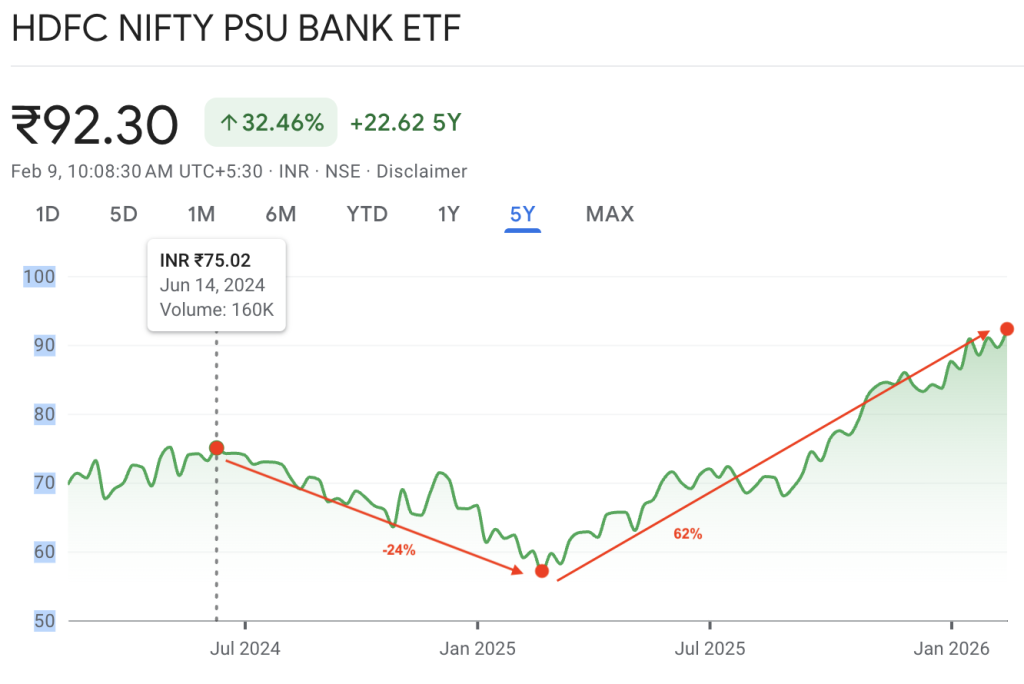
- When I started accumulating a PSU bank ETF in June’2024, the PSU index fell by -24% in the next 6 months. But since then, it has increased by 62%.
- In October 2024, when I started buying a few FMCG stocks, the FMCG ETF was already down -10%. In the next 5 months, it fell another -14%. Today, since the Feb’2025 low, the ETF is up only by 3%, but a few individual stocks are up by about 15%.
- In July 2018, when I started accumulating Metal stocks, the index was already down 20% since its January highs. But at that time I did not know that the index would fall another -30% in the next 1 year. Today, those same stocks yield about 20% CAGR.
- In July 2015, I started accumulating a few IT stocks. At that time, the Index was already -10% down. In the next 12 months, the index dipped by another -10%. Those same stocks are still in my portfolio, yielding close to 15% CAGR. In a 10 Year horizon, 15% CAGR is equivalent to 4x returns.
So, what is the learning?
Today, before buying any stock, I ask a simple question:
Would I be comfortable holding this business if its price crashed by -30% in next coming months? Do I’ve so much faith in its brand name, products, management, etc that I can live with it even in its worst phases?
I ask you to note the shift. When I started, I used to take only price-based decisions. Now, my stock investing decisions have become more business-focused.
This perspective has changed everything about how I invest today what I will do in times to come.
Timing still matters, but conviction matters more.
2. The Market Rewards Our Patience, Not Our Activities in the Market
When I started investing, “doing something” felt like I was doing something more productive than doing nothing.
I hope you can feel what I’m trying to say. Buying, selling, switching, such activities make us feel that we are working, and hence, it creates the illusion that we are in control.
But markets are least bothered about how busy we have been in the past. What it rewards is definitely not constant actions, right?
- The mutual fund investments I sold early might have compounded quietly had I simply left them alone.
- The same pattern repeated with stocks later. I sold a few of my first purchases too soon. I was only reacting to short-term movements. I was certainly confusing motion with progress.
But over time, I began noticing a pattern. Those stocks that went on to become multipbaggers had a common trait:
The biggest returns often come from long holding periods. Quality stock which laid idle for years went on to become 4-5x in years to come.
This process might sound obvious, but it is psychologically difficult to do nothing and let the stocks in the portfolio sit idle.
This is especially true when we have to watch a stock remain flat for years. It can test our patience. During such times, when we see others make quick gains. It creates a doubt about our holdings. In such times, it sounds very logical to sell our average-performing stocks and jump on the
Financial news can further amplify the noise around that is already telling us to do something. When we do not act, it makes our inactivity feel like negligence (it almost feels like a crime).
But this is a fact that my portfolio started improving only when my activity was reduced. It took me at least 5-6 years of portfolio building to realize this psychological anomaly.
In investing, patience does not mean doing nothing out of laziness. It means consciously choosing to stay invested and giving compounding enough time to do its job.
3. Buying a Stock Is Easy, But Holding It Is the Real Skill
During my initial years of stock investing, from 2008 to 2012, buying stocks felt exciting. But as time passed by, holding the same stocks during uncertain times was not an easy decision at all.
Every correction raised questions:
- Did I make a mistake?
- Has the business changed?
- Should I exit before losses grow?
- Are there better bets than these?
When you are new to investing, every price fall feels like something is going wrong. Every price volatility makes stock investing feel like the riskiest thing, like gambling. But after spending a few quality years in the market, you begin to see that price fluctuations are simply part of how markets function.
The ability to understand this difference, between temporary volatility and real risk, is what gradually shapes someone into a long-term investor.
- Volatility: It is a temporary price movement in a stock. Generally, it does not reflect changes in business fundamentals.
- Real risk: It is also a chance, but it happens when the business permanently loses its ability to create value for shareholders
When we hold a stock through cycles, we will have to face multiple situations where we have to decide if a major change in price is just due to volatility or due to a real risk. The answer may look simple now, but to answer it when the situation actually comes, we require the following:
- trust in business fundamentals,
- emotional stability,
- and clarity about why the stock was purchased.
These qualities cannot be developed by reading general books on stock investing.
- Financial Reports: A long-term investor must know how to read the financial reports of companies. This will help to comprehend the fundamentals of the company.
- News: The investor must stay updated about the major events (news) in their holding companies. This will help us understand if the change is due to any current new event.
This kind of understanding about a company will only come when we stay invested through uncomfortable periods.
Over time, I realized that portfolio returns are determined less by stock selection alone and more by my ability to hold fundamentally strong businesses long enough for their growth and compounding to reflect in the portfolio.
Many good investments fail not because the business performs poorly, but because the investor exits too early.
New investors think that stock selection is hard, but I will say, holding is harder than buying.
4. Markets Teach Behavior Before They Teach Finance
In the beginning, I thought investing was mainly about learning finance. I thought that if I could master ratios, balance sheets, P&L statements, and valuation methods, I would become a successful investor.
Do not get me wrong, all of these are important for long-term investing. But when your investment horizon is as long as 20-30 years, something else becomes even more important.
Analytics is important, but it is not the first lesson that markets will try to teach you in the initial years.
The market will first teach the investor how to behave in the market. How is the teaching done?
- It will expose us to impatience when prices stagnate.
- It will expose us to fear during corrections or a crash.
- And I think, most importantly, it will expose us to overconfidence during bull markets.
The 2008 crash and later market cycles showed me something I did not expect: emotional reactions influence returns more than analytical mistakes.
For example, when I bought DLF after the crash, it was not the result of any deep analysis. It was a reaction to falling prices with a perception of quick windfall gains. This kind of action can sometimes work, but most times it will not. Why? Because it is not a repeatable strategy.
As years passed, I started focusing more on decision processes than outcomes:
- Why am I buying this stock?
- What assumptions am I making?
- What would make me sell?
This behavioral awareness improved my investment decisions. Now, I was relying more on my ability to take a right decision than being dependent on any particular metric.
[Note: Over the years, I have converted my decision matrix into a stock analysis algorithm. Between 2016 and 2023, it was in the form of Excel Logics and formulas. These days, it’s the algorithm of my Stock Engine app.]
These days, I follow this rule: Understanding businesses matters, but understanding oneself matters more.
5. Long-Term Investing Is a Mindset, Not a Time Period
Only a few years back, I used to firmly believe that long-term investing simply means holding stocks for many years (say 10-15-20 years). But now that I’ve been building my investment portfolio for about these years, I’ve realized that this definition of long term investin is incomplete.
Why?
Long-term investing is actually more about how decisions are made, not only about how long stocks are held.
The shift in mindset became clearer after 2017, when investing became a full-time commitment alongside blogging.
Over time, portfolio construction became a more thoughtful process for me. Instead of simply buying stocks that looked attractive at the moment, I began approaching each purchase with the mindset of owning a business for the long term. The intention was always to hold for a lifetime, even though the actual holding period might sometimes be shorter.
This is what I actually call a long-term mindset.
It changed my investment behavior in subtle ways:
- I began to study the business more deeply.
- I was worrying less about daily price movements.
- My focus on management quality and industry durability became almost 2x.
- Now, I think in decades instead of quarters when I see stocks of a potential company.
It also reduces unnecessary diversification. Instead of collecting many stocks, the portfolio gradually becomes a collection of high-conviction businesses.
Long-term investing, I learned, is less about duration and more about clarity of ownership.
Once this mindset develops, markets feel less like trading platforms and more like mechanisms for participating in business growth.
Conclusion
After spending so many years building my stock portfolio, one realization is very clear to me: stock is less about buying and selling stocks and more about the accumulation of wealth.
Most of us generally see the stock market from the perspective of price and volatility. But its power is much more than that.
We must realize that the market will always fluctuate. News headlines will always create noise. The uncertainty that is linked with the economy, industry, businesses, stocks, and their investors will never disappear.
What can gradually change (or get enhanced) is how we respond to these things.
In the early years, investing felt like a series of decisions about stocks. Over time, it became a process of building judgment.
- We can learning when to act, when to wait, and when to simply do nothing and trust the work already done.
It is true that this shift does not happen in a single market cycle. It happens slowly, through mistakes, patience, and through lived experience.
If there is one thing long-term investing teaches, it is this: clarity will not not come before investing. We’ll have to first invest, book losses, observe gains, and above all experience the power of compounding. This will only happen when we keep investing and more importantly. stay invested.
The stock market is like our work (job). It does not reward intelligence alone; it rewards consistency of behavior over long periods of time. Intelligence is only one of the deliverables.
In fact, we can mimic intelligence by using trusted stock analysis algorithm like that of my Stock Engine. But what’s more important is how, we as investors, behave in the market.
And perhaps that is why the most valuable investing lessons are hardly found in books or courses. They come from watching our own portfolio over the years. When we slowly becoming comfortable with the idea that wealth creation is usually quiet, gradual, and uneventful. We must learn to stay invested in quality companies no matter how noisy is the market from outside.
So, these are the five things about stock investing I wish I knew when I started investing in stocks in 2008:
- Conviction matters more than perfect entry timing. We must learn to understand business deeply and trust their long-term growth potential.
- Market reward patience. It is needless to act everyday in the market. Buy and forget.
- Holding quality stocks is harder than buying them.
- Behavioral discipline matters more than financial knowledge.
- Long-term investing begins with ownership mindset.
Have a Happy Investing.
