
How Fast HDFC Bank is Expected To Growth After the Merger [10-Year Projection]

Introduction
When I look at HDFC Bank today, I see two things at the same time.
- First, I see a bank that is going through a kind of difficult period. Its stock price is falling, its chairman, who resigned citing ethics concerns, and its margins have been compressed for two years.
- Second, in this bank, I also see one of the most powerful financial franchises in Indian history. HDFC Bank is sitting on top of the Indian credit market, which remains deeply underpenetrated.
They might sound counterintuitive first, but these two things can both be true at the same time.
And I think that is exactly the tension that is making long-term investors confused right now.
- Should you hold?
- Should you exit?
- Is the current weakness a temporary post-merger digestion phase, or
- Is there something more structural going wrong?
I have spent time studying the actual financial statements (last 10 Years) of both erstwhile HDFC Limited and HDFC Bank. I have done some calculations to estimate the next 10-Year growth rate for the HDFC Bank.
In this post, I want to share the result of my analysis with you.
I’ll share my 10-year growth projection for the merged entity.
HDFC Bank is now = HDFC Ltd + HDFC Bank.
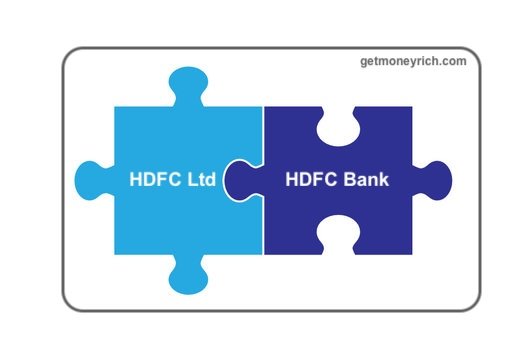
I will share with you whether this bank is a better or worse now (post-merger) in terms of its future growth prospects.
So, let’s start the discussion.

Table of Contents
1. The Big Merger
The merger between HDFC Limited and HDFC Bank was announced in April 2022 and completed in July 2023.
At the time, it was seen as two giants merging to build a behemoth in the world of business.
- HDFC Limited was India’s respected housing finance company. It had been lending home loans since 1977. Its underwriting standards were best-in-class. It always maintained very low NPA levels. were consistently low. Over the years, it has built a customer franchise that can take decades to create.
But HDFC Ltd had one basic limitation. To lend home loans, it needed funds, and it funded itself through bonds and NCDs. This type of source of funds is relatively more expensive. Because HDFC Ltd was an NBFC, and not a bank, it had no other economic way to raise funds. Like banks, it could not access low-cost savings deposits from ordinary people.
- HDFC Bank, on the other hand, had something HDFC Limited did not have. This bank had a massive branch network and a low-cost deposit base. Roughly 35-40% of the deposits of HDFC Bank were zero-interest current accounts and low-interest savings accounts. How? Because of its huge retail customer base across every city and town in India.
Together, the merged entity would combine HDFC Limited’s home loan expertise with HDFC Bank’s cheap funding and distribution muscle.
This way, upon merger, the board of directors of the two companies was trying to create an unstoppable financial powerhouse.
That was the plan.
The reality, as is often the case with large mergers, has been more complicated.
What did the merger actually do to the bank’s financial like profitability and LDR ratio? To get a simple answer to this question, you can read this blog post.
2. Where HDFC Bank Stands Now (The FY25-26)
As of FY25 (March 2025), the merged HDFC Bank has:
| SL | Description | Amount (Rs. Cr.) | Remarks |
| 1 | Total Assets | 43,92,417 | Second largest bank in India after SBI |
| 2 | Loan Book | 27,24,938 | Up 6.2% year-on-year (deliberately slow, managing the LDR) |
| 3 | Deposits | 27,10,898 | growing faster than loans — a positive signal |
| 4 | Net Interest Income (NII) | 1,52,473 | – |
| 5 | Net Profit (Consolidated) | 73,440 | up 12.2% YoY |
| 6 | Return on Equity (ROE) | 13.66% | – |
| 7 | NIM (%) | 3.5% | – |
| 8 | EPS (Basic) | 93/share | – |
| 9 | Shares Outstanding | 765.22 | Crore numbers |
For reference, consider what the two entities looked like separately in their last pre-merger year (FY23).
| Description | HDFC Ltd. | HDFC Bank | Combined HDFC (Ltd + Bank) |
| Net Profit (Before Merger) | Rs 16,239 crore | Rs 46,149 crore | Rs 62,388 crore |
| Net Profit (After Merger FY25) | – | – | Rs. Rs 73,440 crore, growth of 8.5% CAGR in 2 Years. Before the merger, HDFC Bank was along growing at 20% CAGR |
This data is capturing the merger drag very precisely for HDFC Bank.
The bank absorbed a huge amount of structural headwind, and its earnings growth rate has slowed down as a result.
But the main question is, when will the HDFC Bank start re-accelerating at the old pace?
3. My 10-Year Projection for FY35
I’ll share my analysis very transparently here without worrying about the accuracy of my analysis. What I want to share with you is my reading of HDFC Bank’s business.
I will show you exactly how I arrived at my numbers, what assumptions I made, and why.
You can agree or disagree with my assumptions. But I want to show how I’ve done the maths.
Assumption 1: India’s Nominal GDP Grows at 10.5% Per Year
- India’s real GDP is expected to grow at approximately 7% annually.
- I’ve added 3.5% inflation,
- What I got is nominal GDP growth of approximately 10.5% (a slightly conservative estimate).
Assumption 2: India’s Banking Credit Grows at 13% Per Year
Credit has historically grown at 1.2-1.3 times nominal GDP in India.
India’s mortgage-to-GDP ratio is currently only 11-12%, compared to 28% in China and 51% in the US.
This gap will close gradually over the next decade. As the incomes would rise, more urbanisation would take place the mortgage-to-GDP ratio of India would go up.
As more formalization of the Indian economy takes place, like the transition of economic activities from unregistered, unregulated, and cash-based (informal) sectors to registered, regulated (formal), the ratio will go up.
More people, more businesses would need real estate-based (mortgage) based loans.
An independent research by CRISIL and others projects India’s mortgage market will grow at a 13-15% CAGR through FY35.
But for my calculation, I’ve used 13% as the credit growth assumption for HDFC Bank’s loan book.
Assumption 3: NIM Recovers Gradually from 3.5% to 3.9%
I think this is the most critical assumption I’ve made in my growth calculation.
My reasons are here for you to see.
- HDFC Limited’s expensive borrowings from bonds and NCDs were on average 7-year maturity instruments. These funds were raised at a cost of approximately 6.5-7%. Many of these bonds and NCDs will mature and run off between FY28 and FY31. As they do, the HDFC Bank’s overall cost of funds will fall meaningfully thereafter. I am modelling this as a phased recovery:
- FY25 to FY27: NIM will stay flat at 3.5%. This is the phase where the bank is still digesting the merger.
- FY28 to FY30: NIM improves to 3.7%. With expensive HDFC Ltd bonds maturing and cheaper bank deposits replacing them, the NIM would go up.
- FY31 to FY35: In this phase, I think the NIM would stabilise at 3.9%. This is the period where I think the NIM is approaching pre-merger levels.
A recovery from 3.5% to 3.9% over six years is, in my view, conservative, hence I think is very much possible.
Pre-merger HDFC Bank was running NIMs of 4.1%. I am not assuming a full recovery of the merged business as the joint corporation has become too big.
Hence, I am factoring in a permanent discount of about 20 basis points for the larger mortgage portfolio mix.
Assumption 4: Other Income Grows at 12% Per Year
HDFC Bank’s other income now includes the following:
- Consolidated fees,
- Insurance income from HDFC Life,
- Broking income from HDFC Securities, and
- Fee income from HDB Financial Services.
This pool is large and growing faster.
In FY25, other income stood at Rs 1,34,549 crore.
I’m assuming that this portion of the income would grow at a 12% CAGR. At this rate, it will become a significant contributor by FY35.
Assumption 5: Operating Expenses Grow at 10% Per Year
HDFC Bank is also investing heavily in branches and technology. This is an extra expense for the bank, which is also weighing down on its Net Profit and EPS.
But, as the revenue base of the bank expands, operating leverage would kick in.
I am assuming costs grow at 10% annually versus revenue growth of 13-14%. This way, I’m assuming a gradual improvement in cost efficiency for the bank.
Had this been any other bank, this differential between 10% and 13-14% could have been questioned. But the way HDFC Bank has performed in the last 10-15 years, I think these numbers are good.
Assumption 6: Credit Cost at 0.65-0.70% of Loan Book
HDFC Bank’s Gross NPA (GNPS) is 1.24%, which is kind of excellent by Indian standards
It is better than peers like ICICI Bank and Axis Bank, who are running at approximately 1.5%.
I am assuming the Gross NPA of HDFC Bank stays as managed in the coming years as well.
Assumption 7: 1% Annual Share Dilution
The bank issues shares every year through ESOPs and other schemes. In a corporate world these days, I think this has become a new norm.
For an organization as large as HDFC Bank, I think ESOPs cannot be avoided.
I am assuming approximately 1% equity dilution due to ESOPs per year.
This way, the FY35 shares outstanding of HDFC Bank will be approximately 846 crore.
Shares (FY35) = 765.22 * (1+1%)^(10) = 846 crore shares
The Growth Rate Calculations
- Step 1: Project the Loan Book at 13% CAGR
- FY25 Advances: Rs 27,24,938 crore
- FY35 Advances: Rs 27,24,938 × (1.13)^10
= Rs 27,24,938 × 3.394 = Rs 92,47,000 crore (approx)
- Step 2: Project Total Assets at 13% CAGR
- FY25 Total Assets: Rs 43,92,417 crore
- FY35 Total Assets: Rs 43,92,417 × 3.394
= Rs 1,49,06,000 crore (approx)
- Step 3: Project Net Interest Income (NIM × Assets, in phases)
| Year | Total Assets | NII = Total assets x NIM |
| FY27 | Rs 43,92,417 × (1.13)^(2) = Rs 56,09,000 crore | @3.5% NIM Rs 56,09,000 × 3.5% = Rs 1,96,315 crore |
| FY30 | Rs 43,92,417 × (1.13)^(5) = Rs 80,89,000 crore | @3.7% NIM Rs 80,89,000 × 3.7% = Rs 2,99,293 crore |
| FY35 | Rs 1,49,06,000 crore | @3.9% NIM Rs 1,49,06,000 × 3.9% = Rs 5,81,334 crore |
- Step 4: Project Other Income at 12% CAGR
- FY25 Other Income: Rs 1,34,549 crore
- FY35 Other Income: Rs 1,34,549 × (1 + 12%)^(10)
= Rs 1,34,549 × 3.106 = Rs 4,17,949 crore
Step 5: Calculate Total Net Revenue
Total Net Revenue = FY35 NII + Other Income: Rs 5,81,334 + Rs 4,17,949
= Rs 9,99,283 crore (For reference, FY25 total net revenue was Rs 2,87,022 crore)
[Implied revenue CAGR: (9,99,283 / 2,87,022)^(1/10) − 1 = 13.2% per year]
- Step 6: Deduct Operating Expenses at 10% CAGR
- FY25 Operating Expenses: Rs 1,76,605 crore
- FY35 Operating Expenses: Rs 1,76,605 × (1 + 10%)^(10) = Rs 1,76,605 × 2.594 = Rs 4,58,193 crore
- Pre-Provision Operating Profit: Rs 9,99,283 − Rs 4,58,193 = Rs 5,41,090 crore
- Step 7: Deduct Provisions (0.70% of FY35 loan book)
- FY35 Provisions: Rs 92,47,000 × 0.70% = Rs 64,729 crore
- Step 8: Calculate Pre-Tax Profit
- Rs 5,41,090 − Rs 64,729 = Rs 4,76,361 crore
- Step 9: Deduct Tax at 27%
- Tax: Rs 4,76,361 × 27% = Rs 1,28,617 crore
- Step 10: Net Profit FY35
- Rs 4,76,361 − Rs 1,28,617 = Rs 3,47,744 crore
The Summary of My 10-Year Projection
| Metric | FY25 (Actual) | FY35 (Projected) | 10-Year CAGR |
|---|---|---|---|
| Loan Book | Rs 27,24,938 Cr | Rs 92,47,000 Cr | 13.0% |
| Total Assets | Rs 43,92,417 Cr | Rs 1,49,06,000 Cr | 13.0% |
| Net Interest Income | Rs 1,52,473 Cr | Rs 5,81,334 Cr | 14.3% |
| Other Income | Rs 1,34,549 Cr | Rs 4,17,949 Cr | 12.0% |
| Net Profit | Rs 73,440 Cr | Rs 3,47,744 Cr | 16.8% |
| EPS | Rs 93 | Rs 411 | 16.0% |
| ROE | 13.66% | ~16.5% | Improving |
| NIM | 3.5% | 3.9% | Recovering |
* Net Profit CAGR of approximately 16.8% per year over the next decade (till FY35).
* EPS CAGR of approximately 16.0% per year. It is slightly lower due to share dilution.
4. Is the Merged HDFC Bank a Better or Worse Investment Than the Pre-Merger Bank?
And my answer is this: “temporarily worse in speed, but for long-term better in size and depth.“
Let me explain both sides clearly.
Why is it temporarily worse?
The standalone HDFC Bank was compounding profits at approximately 20% CAGR before the merger.
My 10-year projection shows the merged entity compounding at approximately 16-17%.
So yes — in terms of raw earnings growth speed, the merger has slowed things down.
That is the truth, and I think anyone who tells otherwise is not looking at the numbers carefully.
The merger is dragging the bank down and will persist for another 2-3 years at minimum.
Why is it better in the long term?
However, we must alow appreciate that HDFC Bank is now compounding from a base that is nearly 64% larger than it was before the merger.
- The FY23 pre-merger loan book was Rs 16,61,949 crore.
- The FY25 post-merger loan book is Rs 27,24,938 crore.
Even at a slower growth rate of 16-17%, the absolute rupee addition to profits every single year is now far larger than it would have been as a standalone bank growing at 20%.
Just to give you a sense of what I’m trying to say here, consider this example:
- You earn Rs. 20 – when a 20% return is generated on Rs. 100
- You earn Rs. 27.9 – when a 17% return is generated on Rs 164.
Now, apply compounding to it for the next 10 years, and you will see a huge difference in cash earnings.
The merged entity, despite its lower growth rate, is generating more absolute wealth per year for its shareholders.
What factors are working in favour of the shareholders?
- The mortgage opportunity is enormous. India’s mortgage-to-GDP ratio is 11-12% today. China’s is 28%. The United States is at 51%. HDFC Bank, with HDFC Limited’s deep mortgage expertise now inside its balance sheet, is positioned like no other bank in India to capture this structural growth. This franchise did not exist before the merger. If I want to put a price on this advantage, it will be difficult, but it’s a huge benefit for the bank.
- The NIM recovery is a hidden tailwind. When HDFC Limited’s expensive bonds (raised at 6.5-7%) were taken on by the bank, they compressed margins immediately. But these bonds have a finite life – they will gradually expire. As they mature and run off over FY28-FY31, the bank’s cost of funds will improve. Every 10-basis-point improvement in NIM on a Rs 1,49,06,000 crore asset base by FY35 adds approximately Rs 14,900 crore to annual NII. The NIM recovery alone, over the next six years, will add hundreds of crores to the bank’s bottom line, and this is happening even with zero growth. I will say, it is a pure mathematical improvement as the expensive liabilities (bonds & NCDs) mature over time.
- The cross-sell flywheel has not even started properly. HDFC Limited’s home loan customers were largely single-product customers. They paid their EMIs and had no deep engagement with HDFC Bank. Now they are inside the bank’s ecosystem. Over the next 5-7 years, these customers will be offered savings accounts, credit cards, personal loans, insurance, and SIP investments. The fee income generated from cross-selling this base will be significant. This compounding of non-interest income has not shown up fully in the numbers yet.
The above three benefits are huge for the bank. They are capable of building a moat for HDFC Bank like no other bank in India.
This benefit will start showing in the EPS growth in times to come. But for that, the shareholders will have to stay patient at least for the next 2-3 years.
Conclusion
The merger of HDFC Limited and HDFC Bank has made the combined entity a slower compounder in the short run, but a more powerful compounder in the long run.
- The earnings growth rate has come down from the pre-merger 20% to my projected 16-17%.
- But the base is 64% larger.
The bank is expected to benefit from the mortgage underpenetration, rising incomes, urbanisation, and the cross-sell opportunity. A combined customer base of HDFC Ltd and HDFC Bank, of over 120 million people, can make this bank a compounding machine again for the next 10-15 years.
The current period of weakness is only a short-term pain (for long-term gain).
Disclaimer: This post is only my way of sharing my learnings with my readers. Should not be treated as investment advice in any way.

Thanks for sharing your expertise