
The Earnings Yield Premium: A Value Investing Strategy

Discover Earning Yield Premium
Table of Contents
Introduction
If you wondered why some stocks seem to outperform others despite similar fundamentals, the earnings yield premium can be one of the prime reason behind it.
We’ll dive deep into the relationship between earnings yield and stock returns.
We’ll also look at the earning yield premium from the perspective of a stock investor (analyst). We are always looking for tools to pick the right stocks, right?
Earnings yield and earnings yield premium are two concepts that can help us in this direction.
People often use these two terms interchangeably. But they’re not the same.
In this blog post, I’ll clarify their differences and also highlight how to use them in practical investing (you can also jump to the comparison table from here itself).
1. What Is Earnings Yield EY)?
Earnings yield is a simple and straightforward metric.
It tells you how much a company earns relative to its stock price. You calculate it by dividing the earnings per share (EPS) by the stock price.

For example:
- If a company’s EPS is Rs.20, and
- Its stock price is Rs.200,
- The earnings yield (EY) is 10% (= 20/200).
It’s like the “return” you’re getting from the company’s earnings (net profit) for each rupee you invest in the stock.
What is the utility of earnings yield (EY) in practical terms?
Earnings yield helps you compare stocks to other investments, like bonds. If a stock’s earnings yield is 7% and a government bond yields is also 7%, you will think why to take the risk with stocks, right?
While investing in stocks we must factor in the volatility risk associated with stocks. Bonds returns are fixed, but stocks returns are not. To get the same 7% returns, you might need to hold your longer. But bonds will give the said 7% return on the promised date.
So, in order for the stocks to be worth your consideration, their earning yield should be significantly higher than that of the earning yield of risk free options like bonds, bank FD’s, etc.
Now that we know what is earning yield, let’s look at the meaning of earning yield premium.
Suggested Reading: Earning Yield & The Magic Formula of Joel Greenblatt
2. What is Earning Yield Premium (EYP)?
Earnings yield premium (EYP), a concept that can help investors spot opportunities in the stock market.
The earnings yield premium is the extra return you might get from investing in stocks with high earnings yields compared to those with low earnings yields.
It’s not about one stock but a pattern across the market.
If earning yield premium can be expressed as a formula, it will look like below:

EYP = Avg. Return (High EY Stocks) − Avg. Return (Low EY Stocks)
The formula measures the difference in average returns between two groups of stocks over a period.
- High earnings yield stocks are typically “value” stocks, trading at lower prices relative to their earnings.
- Low earnings yield stocks can be “growth” stocks, priced higher due to future potential.
- Earning yield premium shows how value stocks tend to outperform growth stocks over time.
3. Why Earning Yield Premium is Important For Investors?
The earnings yield premium is a concept which highlights the potential of investing in value stocks. To learn more about what is ‘value investing’ read this post.
- Stocks with high earning yields can be undervalued. We can call them value stocks. It is easy to find such stocks in sectors like finance, PSUs, manufacturing, or any out of favour sectors.
- These types of stocks often tend of outperform low earning yield stocks.
- Note: Some might try to sell you those low earning stocks tagging them as “growth stocks.” It is important to remember that not all low earning yield stocks are growth stocks. I think, the possibility of a stock to qualify for the tag of a ‘growth stock’ is one in one hundred.
- With this perception about the stock market, I’ll say, it is much safer to invest in high earning yield stock which has the potential of yielding us high earning yield premium.
Market sentiment can shift with RBI policy changes or global oil price shifts. For we investors, earning yield premium can be our guide for long-term wealth creation.
Let’s me give you a general view of what it means by investing in stocks displaying high premium.
When you invest in stocks with high earnings yields, you’re betting on companies the market has overlooked. In stock market, these stocks are like hidden gems in a crowded bazaar.
These stocks trade at low prices relative to their earnings. Hence, they can deliver strong returns when their true value is recognized.
We can buy these stocks during market corrections and experience the compounding during economic recoveries.
Why it matter? Because it counters our temptation to chase hyped-up stocks.
- Growth stocks like tech or consumer companies do well during bull runs. Like, growth stocks like Zomato, Infosys etc stocks did so well 2021-2022. But when markets cool, and their earnings do not deliver as expected, these same stocks underperform badly.
- Meanwhile, high earnings yield stocks, like those in banking or energy, tend to hold steady or rebound faster.
Historical data backs this trend.
Studies on the BSE Sensex show value stocks outperforming growth stocks over decades, especially post-crisis periods like 2008-09 or 2020.
For investors, the premium is a reminder to stay disciplined, avoid herd mentality, and seek value in sectors others ignore.
Practically, the earnings yield premium helps us build a smarter portfolio.
We can tilt our preference toward high-yield stocks, to capture outperformance over time. In a market like India, which is more cyclical than matured markets like US, this approach can fetch us relatively higher premiums.
For example, during a commodity slump, stocks like Tata Steel or JSW Steel might have high yields due to low prices, offering a buying opportunity.
But what such people should do who do not understand stocks a lot? They can invest in mutual funds or ETFs focused on value investing to spread risk.
Focusing on premium also encourages us to be patient with our holdings. Because we know that it may take years for these stocks to get noticed by others.
In a market swayed by news and FII flows, understanding the concept of earning yield premium gives us an edge over other investors.
Now, let’s see this in action with an example
4. Example: Indian Oil vs. HDFC Bank
To explain the earnings yield premium, I’ll compare two Indian stocks: Indian Oil Corporation (IOC) (a high earnings yield stock) and HDFC Bank (a low earnings yield stock).
I’ll use recent data to calculate their earnings yields and historical returns, then apply the formula. This will show how the premium works.
Step 1: Calculate Earnings Yield for Each Stock
Earnings yield = EPS / Stock Price × 100.
Let’s take the data as of August 2025.
- IOC:
- EPS (TTM): Rs.9.63
- Stock Price: Rs.143
- Earnings Yield = 9.63 / 143 × 100 = 6.73%
- HDFC Bank:
- EPS (TTM): Rs.91.96
- Stock Price: Rs.1,995
- Earnings Yield = 91.96 / 1,995 × 100 = 4.61%
IOC has a higher earnings yield (6.73%) than HDFC Bank (4.68%).
This makes sense. IOC, a PSU in the oil sector, is a value stock with stable earnings but a lower stock price.
HDFC Bank, a private bank, is a growth stock with a comparatively higher P/E ratio. High P/E is generally considered as reflective of the market optimism about its future.
Step 2: Compare Historical Returns
To calculate the earnings yield premium, we need the average returns of high and low earnings yield stocks. For simplicity, let’s assume IOC represents high earnings yield stocks and HDFC Bank represents low earnings yield stocks.
We’ll look at their 5-year returns as of August 2025.
- IOC 5-Year Return:
- Stock price 5-year ago: Rs.57.6
- Current Price = Rs.143
- 5-Year Return (CAGR): 19.95% p.a.
- HDFC Bank 5-Year Return:
- Stock price 5-year ago: Rs.1,044.
- Current Price = Rs.1,995
- 5-Year Return (CAGR): 13.82% p.a.
Step 3: Apply the Earnings Yield Premium Formula
EYP = Avg. Return(High EY Stocks) − Avg. Return(Low EY Stocks)
- High EY Stocks (IOC): 19.95%
- Low EY Stocks (HDFC Bank): 13.82%
- EYP = 19.95% − 13.82% = 6.11%
Step 4: Interpreting the Result
Using the 5-year CAGR data the EYP we got is 6.11%.
What does it mean?
This means that over the past five years, high earnings yield stocks like IOC outperformed low earnings yield stocks like HDFC Bank by 6.11% annually.
This aligns with the historical pattern of the earnings yield premium.
Value stocks tend to deliver better returns over longer periods (except a few rare growth stocks).
The 6.11% premium tells us IOC’s high earnings yield (6.73% in 2025) signaled undervaluation. This paid off as its stock price grew faster than HDFC Bank’s.
A comparatively faster growing stocks (than IOC), like HDFC Bank with has lower yields (4.61%), often ride high during bull markets but can lag when sentiment shifts or earnings growth slows.
For instance, IOC likely benefited from rising oil prices or PSU sector strength. While HDFC Bank faced headwinds like margin pressures (due to provisions) and slower loan growth.
This positive EYP highlights the advantage of betting on undervalued stocks for long-term gains.
For Indian investors, this result also underscores the power of patience.
The earnings yield premium isn’t a quick win, it rewards those who hold high-yield stocks through market ups and downs. It also shows the risk of chasing growth stocks at peak valuations.
While HDFC Bank remains a solid pick, the 6.11% premium suggests value stocks like IOC can offer better returns over time, especially in volatile sectors.
5. How to Use Earning Yield Concept in Real Life
As a stock investor, here’s how you can apply the earnings yield premium:
Indian investors can leverage the earnings yield premium to make smarter investment decisions. Here’s how to apply it practically for stock investing.
- Start with stock selection. Calculate earnings yield (EPS / stock price) for stocks you’re eyeing.
- Compare it to benchmarks like the 10-year government bond yield (around 6.35% in 2025). Hence, a stock like Indian Oil Corporation (IOC) with a 6.60% yield look attractive.
- Dig into fundamentals. Check debt levels, cash flow, and industry trends for example. You can check this post to understand how use fundamental investing for long term wealth creation.
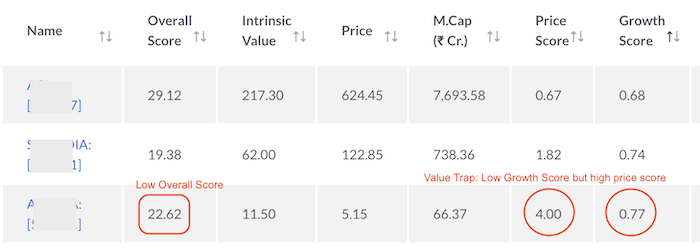
- Use Tools: High yields can signal bargains or risks, so use tools like the Stock Engine to filter stocks with high yields and strong balance sheets. Tip: Look at the pre-built screener called “low PE stock.” Low P/E means high earning yield. In this list, look for stocks whose Overall Score is high.
- Avoid value traps: Be careful of companies with declining profits. These are those companies who P/E will be low (high earning yields) but are still bad. Why? Because their profits are not growing. How to identify value trap stocks? Look into their detail page in the Stock Engine. A stock with low P/E but low growth score is likely a value trap. Check the screenshot below.
- Adopt a long-term portfolio strategy. You can start building your portfolio by adding high growth, ‘high earning yield stocks’. This strategy is in line with the famous GAPR strategy. Read about GARP here. The idea should be to tilt your portfolio weight toward value stocks. Look for stocks in those industries which generally trade at a lower P/E levels, say steel, cement, PSU, banking, etc. But do not buy these stocks just because their P/E is low or earning yield is high. Remember, these stocks generally trade at low high earning yields. Buying at any price will not yield high returns. Buy them when their price corrects by about 10%. After these corrections, when these low P/E stocks rebound, they do it more strongly than other stocks.
- Mutual Funds: People who are not comfortable with stocks, they can go with mutual funds. Consider value-focused mutual funds or ETFs, like the Nippon India Value Fund for example. These funds can also diversify and capture the premium without betting on a single stock.
- Patience is key. Buy high yielding (low P/E) and then give it time to compound. Let them see at least a full cycle. Buy during dips and see one recovery. For this to happen, you’ll have to hold your high earning yield stocks for 3 years minimum. Don’t expect quick gains.
- Finally, manage risks wisely. High earnings yield stocks can be volatile. So, balance your portfolio with a mix of value and growth stocks. Monitor economic cycles. Value stocks thrive in recoveries, while growth stocks lead in bull markets. By blending earnings yield analysis with the premium’s long-term edge, is one good strategy to ride the stock market waves.
6. Difference Between EY vs. EYP
Both the terms, ‘earning yield’ and ‘earning yield premium’ are used interchangeably, but they are different.
| Aspect | Earnings Yield (EY) | Earnings Yield Premium (EYP) |
|---|---|---|
| Definition | A metric: EPS divided by stock price, expressed as a percentage. | The tendency of high earnings yield stocks to outperform low-yield stocks over time. |
| Scope | Applies to an individual stock. | Generally applies to a portfolio or market trend, not a single stock. |
| Calculation | EPS / Stock Price × 100. Example: Rs.10 EPS, Rs.100 stock price = 10% yield. | EYP = Avg. Return(High EY Stocks) − Avg. Return(Low EY Stocks). Example: 19.95% (IOC) − 13.82% (HDFC Bank) = 6.11% over 5 years. |
| Purpose | Measures a stock’s earnings relative to its price to assess value. | Identifies a market anomaly where high-yield stocks may offer better returns. |
| Practical Use | Compare a stock’s yield to bonds or Bank FDs to get the perspective of the stock’s ROI over risk free options | To build a portfolio favoring high earnings yield stocks to capture potential outperformance. |
| Example | ONGC with EPS ₹28.74 and stock price ₹233.85 has a 12.28% earnings yield. | IOC (19.95% CAGR) outperforms HDFC Bank (13.82% CAGR) by 6.11% over 5 years, showing the premium. |
| Risk Highlighter | High yield may signal undervaluation. But it can also highlight risk (e.g., declining earnings). So further analysis is a must. | Premium may not hold in all market cycles. For example, in bull market cycle, growth stocks will beat value stocks. But during recovery from a market slump, high premium stocks will shine. |
| Time Horizon | Useful for immediate stock analysis as it reflects current valuation | Best observed over long periods (5-10 years) to see outperformance to capture consistent outperformance trends. |
| How To Use | Check if a stock’s yield is high compared to peers or bonds. Then, dig into fundamentals for high erning yield stocks. | Study historical data. Tilt your portfolio weight in favour of high-yield stocks for for long-term gains. Buy buy only during dips. |
| Application | Use to decide if a stock like Tata Steel is a bargain compared to its earnings. | Allocate more to value stocks in sectors like metals, Cement, PSU, etc during market corrections. |
Conclusion
The earnings yield premium is a concept we can use to navigate unpredictable stock market.
By focusing on high earnings yield stocks, which can deliver higher premium, over over low yield stocks, we can tap into long-term outperformance.
Use earnings yield to spot undervalued stocks. But after that, always do a deeper fundamental analysis of these stocks. Why it is necessary? Because high yields can hide risks as well. What risk? Price corrections caused by falling profits. We shall not buy such stocks even if their earning yields are high.
Tilt your portfolio toward value stocks in sectors which trade at a comparative lower P/E (or higher earning yields).
Have a happy investing.
