
The 8% Safe Income Trap — Tested With Real Fund Data

A few weeks back, one of my subscribers asked me a simple question.
He wanted his money to be safe. He wanted 8% returns. And he wanted to withdraw it in two days if an emergency came up.
Sounds reasonable, right? That’s what I thought too, until I actually sat down and tested it.
Turns out, you can’t have all three. Not in India.
Let me explain why and show you the actual numbers.
The portfolio that started this
This subscriber is retired. He had some pension going on.
He also built a solid stock portfolio over the years. I know, he has some really good picks with great entry prices that most people would envy.
But the only problem with this is that the person is retired, and all his money, every rupee of it, was sitting in stocks.
The elderly had zero debt and some amount of cash parked in FDs.
Now that’s fine when you’re 45 and building wealth. It’s a different story when you’re retired and need that money to behave.
Because markets don’t move in a straight line. They fall. Sometimes 15-20% in one go. We’ve all seen it happen in 2008 and 2020. If you need cash during one of those drops, you’re forced to sell at the worst possible time.
That’s not a risk you want to be carrying when you are dependent on this portfolio for regular income.
The Triangle
Here’s the real lesson from this whole exercise.
Think of three things: Safe. 8% returns. Instant withdrawal (flexibility to withdraw funds in, say, 2 days).
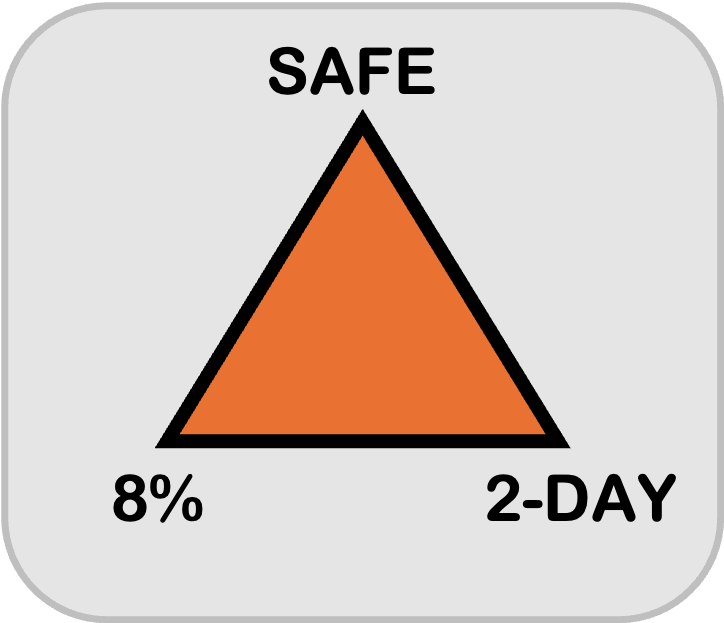
But with an ~8% return expectation, you will get only two, never all three together.
I know for some that may sound like a bold claim, so I went and tested it with actual data. If you look at the variables individually (safety, 8%, and flexibility to withdraw funds), they look harmless. But when the desire is to get all three together as a package, that is when things get complicated.
What the data actually showed
I looked at two mutual funds and their real dividend payout history, going back five years.
- Fund one: It was a conservative hybrid fund. Its portfolio was mostly debt with a small equity portion. Two years back, its dividend yield was touching almost 10%. Today? Down to 6.5%. That’s not a one-off dip either; the whole trend has been sliding down, year after year.
This fund is the PPFAS Conservative Hybrid Fund (Direct) Monthly IDCW (Payout). The actual TTM dividend yield trend I calculated from the fund’s own payout history was: (a) a 5-year holder saw TTM yield peak around 10.09% in Sep-2024, and (b) It had compressed to roughly 6.73% by Sep-2026
- Fund two: It was a pure debt fund. No equity at all. You’d think this one would be rock steady in its dividends, right? It held around 7% for a good couple of years. Then, in just two payouts, that number got cut in half.
This fund is the ICICI Prudential Banking & PSU Debt Fund (Direct) Quarterly IDCW (Payout). TTM dividend yield across every purchase cohort held steady in the 6.6%-7% range through 2023-2025, then fell sharply to roughly 4.0-4.1% by Sep-2026.
These are two very different funds, but you get the same lesson from them.
What is the lesson? A dividend flowing out of mutual fund schemes is not a promise. It moves with the market. The example I took was conservative hybrid funds and debt funds, not equity; still, their returns were volatile.
So when a retired person invests in such “safe” funds for income, they actually do it believing that their payouts will be the same. But even here, there is volatility.
So what about bank FDs?
I compared this against fixed deposits from the big banks.
Senior citizen rates, right now, are sitting between 7% and 7.25% at the large, well-known banks. These are fixed, guaranteed returns with insurance for up to ₹5 lakh through DICGC.
So does that mean FDs win? Not exactly.
An FD gives you certainty, but not the flexibility.
You will have to break the FD, break the whole principal amount, and as a result, you usually lose some interest in the bargain.
A mutual fund, on the other hand, lets you pull out any amount, any day, no penalty. What you gain in flexibility, you give up in certainty.
That’s the actual trade-off between FDs and mutual funds. As we primarily focus on returns, we tend to ignore the benefits of flexible payouts. But for a person whose primary goal is to generate income from the portfolio, flexibility becomes a major factor.
The rule, one more time
Safe. 8%. Instant withdrawal. Pick two.
- A bank FD gives you safe + instant. But the rate is 7%, not 8%.
- A hybrid fund chasing 8% saw its yield fall from 10% to 6.5% in two years. Holding it longer didn’t bring the 8% back; the trend just kept going down.
- A fund we assumed was safe, with quick access, had its payout cut in half overnight. Safe and quick, yes. 8%, no.
So the next time someone pitches you a return that’s safe, gives you 8%, and lets you withdraw instantly, stop and ask one question: which corner are they quietly dropping?
Because in India, right now, 8% is a borderline number for anyone wanting regular income, especially in the first 5-6 years of retirement, when you can’t afford to take chances with your capital.
Have a happy investing.
