
₹26 Lakh Crore Wiped Out in Crash? Where Did the Money Actually Go?

Why I am writing this
Recently, a political party tweeted about the stock market. It said the market has been falling for a month and investors have already lost about ₹17 lakh crore.
We see such headlines every time the market falls. “₹X lakh crore wiped out.”
But does a fall in the index really mean investors lost that much money? Where does that money go? And if we don’t sell, is the loss only on paper?
In this post, I will try to answer these very specific questions. To make it simple, I will use the example of the March 2020 COVID crash.
- On 23 March 2020, the Nifty 50 closed at 7,610.
- Just three weeks earlier, it was at 11,202.
- That is a fall of about 32% in three weeks.
In market cap terms, the Nifty 50 companies were worth about ₹82 lakh crore at the start of March. By 23 March, they were worth about ₹56 lakh crore.
So roughly ₹26 lakh crore was gone in three weeks.
[These market cap numbers are my approximate estimates. The 32% fall is the actual index fall.]
So the question is simple. Did investors actually lose 32%? Did ₹26 lakh crore really vanish from their portfolio (pocket)?
Some people will say, “It is only a paper loss.” Others will say, “Investors lost ₹26 lakh crore.” Honestly speaking, both these statements are nnot correct.
Let me explain why I say so.
Where does the money go when the market crashes?
Let’s start with the biggest myth.
When someone says the market lost ₹26 lakh crore, it sounds like this money left the investors’ pockets and went to somebody else.
But in re3ality, it did not. The money went nowhere.
Let me show this to you with a simple example.
Imagine a company owned by 100 shareholders. Each share is worth ₹100.
One day, something happens in the company and two investors panicked, out of these 100 shareholders, and decide to sell.
A few buyers come forward. But they were ready to buy only at ₹70, not at ₹100. So the trade happens at ₹70.
Now the last traded price of the share is ₹70. And this ₹70 price now applies to all 100 shareholders.
See what happened here?
- Only two people traded.
- But all 100 shareholders got their portfolio value pulled down from ₹100 to ₹70.
This is exactly what market cap is. Market cap is the last traded price multiplied by all the shares of the company.
On any given day, only a very small portion of the shares actually trade. But the price at which they trade is applied to every share.
And what about the cash flow (money transfer)? The buyer paid ₹70. The seller got ₹70. The same money just changed hands between two investors.
So in March 2020, that ₹26 lakh crore did not go into anybody’s pocket.
Yes, some money changed hands. But nowhere close to ₹26 lakh crore. What changed was the price. There was no actual cash flow worth ₹26 lakh crore that happened.
So, is it only a paper loss?
If no money left the market, then it was only a paper loss, right? Nobody lost 32%. Nobody lost ₹26 lakh crore.
This statement is also not completely true.
Ask yourself one question. What is my wealth worth today?
Your wealth is not what you paid when you bought a share or a mutual fund. Your wealth is what you will get if you decide to sell today.
Suppose your portfolio was worth ₹10 lakh before the crash. After the crash, it became ₹6.8 lakh. If you needed money on that day, you had only ₹6.8 lakh. Not ₹10 lakh.
So the loss is real. But there is a small nuance that we must understand.
This loss is reversible.
If prices recover, your portfolio value also recovers. But if you sell on that day, the loss gets locked. It becomes final.
So selling does not create the loss. Selling only makes it permanent. This is how I look at it:
- An unrealised loss is real, but reversible.
- A realised loss is real, and final.
Did all investors really lose 32%?
On 23 March 2020, everybody noted that the Nifty fell 32%.
But did investors, on an aggregate, lose 32%? No. Here’s why.
The 32% is the fall in the index over three weeks. But every investor’s loss depends on the price at which they bought.
| Investor | Bought at (Nifty) | Loss on 23 March 2020 |
|---|---|---|
| Bought near the peak | 12,362 (Jan 2020) | About 38% |
| Bought in early 2017 | 8,500 | About 10% |
| SIP investor | Average of many months | Depends on the average cost |
An SIP investor’s cost is spread across many months or years. So their loss is usually much smaller than the headline number.
So you can see, nobody actually “lost 32%”. Each investor had their own loss number.
But this does not mean nobody lost money. Some people did. Who were they? Those who panicked and sold during the crash.
For them, the loss was real and final.
The headline number vs. the actual money
Let me show you one more comparison.
It will make it clear why “₹26 lakh crore lost” is not the right number to quote.
- In March 2020, foreign investors (FPIs) sold a record ₹61,973 crore worth of Indian equities.
- Who bought these shares? Domestic institutions (DIIs), mainly mutual funds. Mutual funds bought about ₹30,285 crore.
- Withing the DIIs basket, SIP inflows that month were a record ₹8,641 crore.
| What happened in March 2020 | Amount |
|---|---|
| Fall in Nifty 50 market cap (approx.) | ₹26,00,000 crore |
| FPI selling | ₹61,973 crore |
| Mutual fund buying | ₹30,285 crore |
| SIP inflows | ₹8,641 crore |
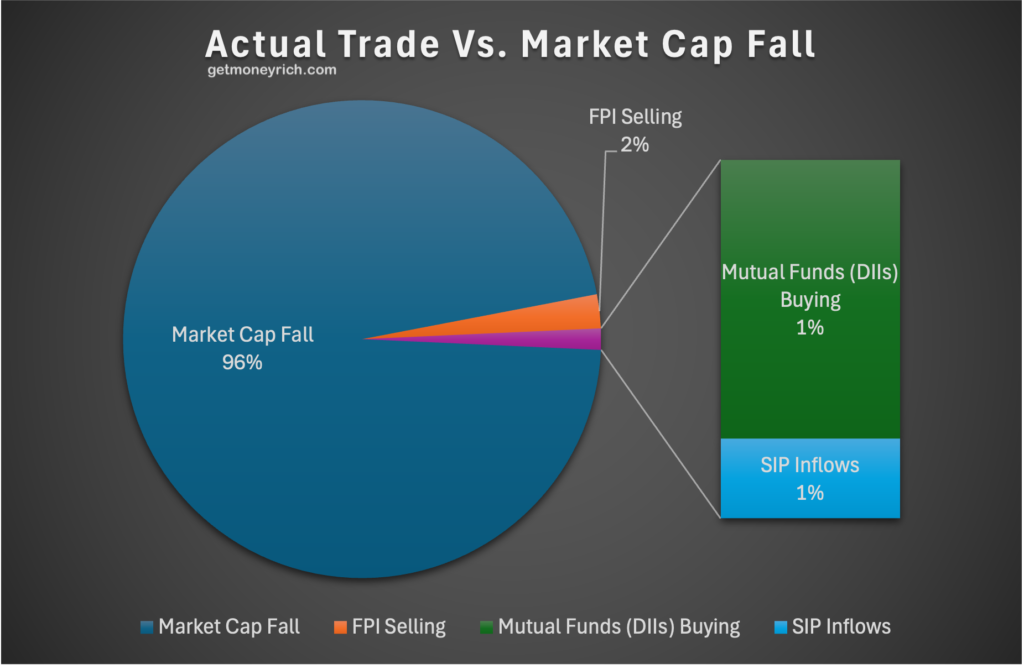
On one side, we have ₹26 lakh crore. On the other side, we have ₹62,000 crore, ₹30,000 crore, and ₹8,600 crore.
Even the record FPI selling was less than 3% of the market cap fall, right?
What does it mean, it means that the actual money that changed hands was nowhere close to ₹26 lakh crore.
And what happened to that ₹26 lakh crore?
By November 2020, the Nifty was back to its pre-crash peak. Within a year, it had nearly doubled from the March bottom. The “lost” ₹26 lakh crore came back.
Those who held on lost nothing. Those who sold during the crash were the ones who actually lost money.
What a crash really means for you as an investor
Think about 23 March 2020. Crores of investors opened their portfolio apps that day. Every screen was red. There was no trace of green.
Add up all those red numbers, and you get ₹26 lakh crore. But only on the screen.
Now let’s look at one investor. She holds 1,000 units of a Nifty index fund. The NAV is ₹100, so her portfolio is worth ₹1 lakh.
The crash comes. The NAV falls from ₹100 to ₹68. Her portfolio is now worth ₹68,000.
But look closely. Before the crash, she had 1,000 units. After the crash, she still had 1,000 units. Her units did not fall. Only the price of each unit fell.
This is the point I want to make. What we actually hold in our portfolio is the number of shares, or the number of mutual fund units. We do not control their price. We only control how many units or shares we hold. Our ownership is in the units, not in the rupee value.
Now take three investors, A, B and C.
| During the crash (NAV ₹68) | After recovery (NAV ₹100) | |
|---|---|---|
| A | Panicked and sold 1,000 units | ₹68,000 cash, zero units |
| B | Did nothing, held 1,000 units | ₹1,00,000, no damage |
| C | Bought A’s 1,000 units for ₹68,000 | ₹1,00,000, a gain of ₹32,000 |
See what really happened here?
- The crash did not move money from A to C.
- It moved units from A to C.
The ownership changed hands, from a scared investor to an investor who was willing to buy during the crash.
The SIP investor is in a similar position.
Suppose her monthly SIP of ₹10,000 was buying 100 units before the crash. At a NAV of ₹68, the same ₹10,000 buys about 147 units. Same money, more ownership.
Conclusion
So what does a ₹26 lakh crore crash actually mean?
It is the total fall in the market value of everyone’s holdings.
But most of those investors did not panic and did not sell.
So most of them were not part of any real loss. For them, the price tag on their units was showing a dip down for a while. Their ownership stayed the same.
But this does not mean nobody lost money. Some people did. They were the ones who sold their shares or units at low prices during the crash. For these people, the loss was real and permanent.
Have a happy investing.
