
EPF Wage Ceiling Hiked to ₹25,000 – Will Your Salary Really Get Affected?

The government has increased the EPFO wage ceiling from ₹15,000 to ₹25,000 per month.
Since this news broke, I have been getting a lot of messages from readers who are confused and a bit worried.
The question is simple:
Does this hike make my PF contribution go up now? And if it does, will my take-home salary come down?
Let me try to explain this in this blog post.
First, what does this “ceiling” actually mean?
The EPF ceiling is the wage limit up to which PF contribution is mandatory. Earlier, this limit was ₹15,000. Now it has been raised to ₹25,000.
This matters a lot for employees whose actual basic salary is below this limit. For them, PF was already compulsory, and it stays compulsory. Nothing new here.
But the confusion is coming from a different group of people.
These are people with high CTC. Those people whose basic salary is already much higher than ₹25,000.
Say someone earning ₹30 lakh a year, with a basic salary of ₹15 lakh a year. For such people, does this ceiling hike change anything? The question these types of people are asking is related to the impact on their take-home salary.
What we may not realize, as per the rules, a lot depends on your company’s policy.
Two types of companies
Some companies use a practice called “capping the PF wage.” They can do this to allow their employees to get a higher take-home salary by compromising their PF contributions.
Even if your actual basic salary is ₹1,25,000 a month, they calculate your PF contribution assuming your basic is only ₹15,000 (or now ₹25,000).
This can keep the PF outgo small and predictable for the company.
If your employer follows this practice, then yes, this ceiling hike will affect you. Your PF contribution will go up, because the base amount used for calculation has increased from ₹15,000 to ₹25,000.
But most companies, especially larger ones, don’t do this.
They simply deduct 12% of your actual basic salary (whatever that number is).
They allow no capping, no shortcuts.
If this is how your company works, then this ceiling hike changes nothing for you. Why? Because your PF was never linked to the ₹15,000 or ₹25,000 number in the first place.
A quick example
Take a person with ₹30 lakh CTC and ₹15 lakh basic salary (50% of Basic).
- If his employer was capping PF at the old ₹15,000 ceiling, his contribution was ₹1,800 a month (12% of 15,000).
- Now, with the ₹25,000 ceiling, it becomes ₹3,000 a month (12% of 25,000).
That is an increase of ₹14,400 a year, which will be adjusted straight out of his take-home salary.
But if his employer was already deducting 12% of his real ₹15 lakh basic, his PF was ₹1,80,000 a year, before this rule and after this rule.
So for such people, there would be no change at all.
Table: ₹30 Lakh CTC, ₹15 Lakh Basic Salary – Before vs After the Ceiling Hike
| Particulars | Employer Caps PF at Ceiling | Employer Uses Actual Basic (No Capping) |
|---|---|---|
| PF wage considered Old Rule (₹15,000 ceiling) | ₹15,000/month | ₹1,25,000/month (actual basic) |
| PF contribution Old Rule (12%) | ₹1,800/month = ₹21,600/year | ₹15,000/month = ₹1,80,000/year |
| PF wage considered New Rule (₹25,000 ceiling) | ₹25,000/month | ₹1,25,000/month (actual basic) |
| PF contribution New Rule (12%) | ₹3,000/month = ₹36,000/year | ₹15,000/month = ₹1,80,000/year |
| Change in annual PF contributions | ₹14,400/year | No change |
| Impact on take-home salary | Take-home reduces by ₹14,400/year | No impact |
So how do you know which category you fall in?
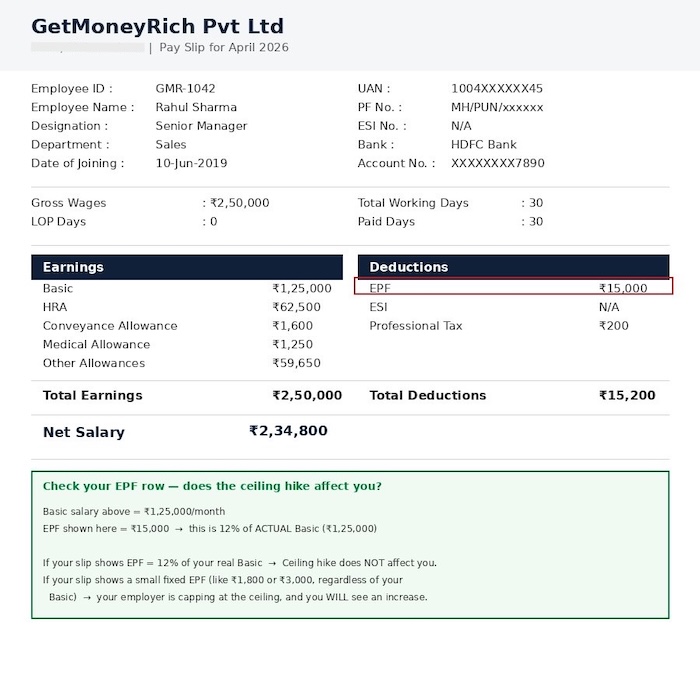
The simplest way is to check your own salary slip issued by the company.
Look at how your PF is being calculated. If the PF wage shown is a small fixed number like ₹15,000, your company is capping it, and this news does apply to you. If the PF wage matches your actual basic salary, you have nothing to worry about.
Conclusion
This ceiling hike is a genuine and welcome step for lower and middle-income employees, since it brings more people under mandatory social security.
But for many high-CTC salaried employees, whose PF is already calculated on their actual basic salary, this change doesn’t affect their monthly take-home.
Take two minutes and check your own payslip. That one look will tell you everything you need to know.
Have a happy investing.
